Showing posts with label footstones. Show all posts

Friday, August 2, 2013

July 2013's Footstones

Being a List of the Assorted Horrors I've Consumed During the Month of July, 2013.


The Conjuring 
(2013) 
dir. James Wan


James Wan's The Conjuring is an excellent major studio-backed horror film, among the most well-crafted in several years. It hits every note of demonic terror to supernatural perfection. Essentially, it's the best Greatest Hits of 1970s-1980s Major Studio Horror that's been produced thus far, incorporating elements of such pop culture titans as The Amityville Horror (1979), Poltergeist (1982), and The Exorcist (1973) into its ceaseless assault of innocent audiences. (Appropriately, those involved had the good sense to make it a period piece set in 1971.) It's good press that The Conjuring is the first film to be given an R-rating by the MPAA not because of any specific content but because it's simply too scary. However, this badge of honor from the MPAA also inadvertently articulates an almost intangible quality of the film itself: it's horror filmmaking at its purest, most refined state. Every accelerated plot point, every dread-filled pause in the action, every move the camera makes is executed for maximum fright effect. To aid this, the filmmakers adopt the feeling of '70s horror alongside its base mechanical parts: The film avoids CGI and paces its jumps with suspense. It establishes a concrete sense of space with the Perron family homestead (one of the more simultaneously beautiful and creepily atmospheric movie houses of recent years) and then drops a thick, palpable layer of unheimlich menace over it. Deplorable teenagers aren't shoved in front of us as our protagonists, but a pair of loving and sympathetic families is. There's no story-betraying sting-in-the-tail twist, just the schmaltzy, reaffirming Poltergeist II-styled message that Love Conquers All (with a little help from Jesus, too: though the film's general lack of cynicism is refreshing, the social and religious conservatism implied by its conclusion is a tad too old-fashioned, supporting (rather sneakily) an overly traditional notion of the family unit as a man and a woman with clearly defined gender roles popping out an endless string of children in service of God. For more on how this implicit message is at odds with the more interesting and dynamic changes to social and cultural values brought about in the '70s, check out Jed Mayer's excellent essay on the film).

All of these deliberate stylistic choices signal that The Conjuring is determined to be a classical horror movie updated for modern viewing sensibilities, much like Wan's two previous horror films, Insidious (2011) and Dead Silence (2007). But The Conjuring sidesteps the eccentric creativity of those previous films in favor of conventionality. Every recognizable scary movie element is here: the dead dog, the child who talks to ghosts, the birds who fly into windows, the hidden basement, the possessed doll, the invisible force that pulls on your feet at night. Noting all of these components helps one to realize that The Conjuring might be the most generic horror film of the past decade, but not to its detriment. The film's effect lies in its ability to compound those elements of horror movie lore into one seamless though overstuffed entity that hurls itself incessantly at its audience and sticks, leech-like, at the back of our necks. It's exhilarating to watch the film push two hours but never outstay its welcome and not once lose the attention of its rapt audience. The Exorcist can't claim that much. 

True, it is a bit of a downer that Wan, one of modern horror's top directing talents, chose to retreat from the slightly more daring propositions of his early horror films, Saw (2004) included, because The Conjuring-- as technically excellent as it may be-- doesn't attempt to add anything new to the genre's repertoire. (Perhaps the absence of his frequent partner, screenwriter Leigh Whannell, has something to do with this relative lack of daring.) Even worse, Wan is beginning to display signs of a desire to move out of the genre, as we might guess from his recent landing of the Fast 7 gig. We're fortunate enough to be the recipients of Insidious: Chapter 2 (2013) a couple short months from now, but if that's the last we see of "James Wan, Horror Filmmaker" for the foreseeable future, then we certainly have a lot less to look forward to. But maybe our future isn't hopeless. The monstrous financial success of films like The Conjuring and The Purge (2013) this year is heartening, for it shows the major studios that they can take risks on mature, inexpensive, and creatively made R-rated horror films because an audience hungry for them indeed exists. (Perhaps unfortunately, the equal success of Texas Chainsaw 3D (2013) back in January also tells them that the easy-to-please teenage audience is still breathing, too.) If the studios decide to take a few more of these chances in the coming years while avoiding the big budget horror flops, remakes, and tossed off sequels of the recent past (all of which have had diminishing returns) the genre will be better off for it. And, who knows, maybe something more bold and original will slip past some executive's desk and into theaters.


Valentine
(2001)
dir. Jamie Blanks


The magnetic tape in my VHS copy of Urban Legend (1988) has degraded to the point that Rebecca Gayheart's irrepressible mane always looks like its snowing, and yet, as frequently as I've enjoyed that supreme slice of late '90s slasher throwback cheese over the years since its release, I've been neglectful in checking out the further work of its Aussie director, Jamie Blanks. Because Blanks displays in Urban Legend the most playful and perceptive understanding of the subgenre of any of his contemporaries during the latter part of the decade, this neglect of his subsequent films is especially egregious with regard to the second slasher flick he directed a mere few years later. Valentine (2001) switches out the stock college campus setting of Urban Legend (which brought to mind such campus slasher classics as Final Exam (1981) and Girls Nite Out (1982)) for that of the equally recognizable holiday party (like those in April Fool's Day (1986) and Killer Party (1986)). Valentine also trades on the time-honored slasher tradition of jilted dorks taking revenge against adults for affronts committed when they were childhood classmates, just like the jilted dorks in Slaughter High (1986) and Class Reunion Massacre (1978) do. Though based on a thriller novel by Tom Savage, it's clear after only peeping at the source material's jacket copy that the basic story was reconfigured by its screenwriters and director with the classic (and less-than-classic) slasher canon in mind. The resulting picture is not quite as much fun as Urban Legend is (it's missing that film's irresistible legend-based hook), but it's roughly as successful with regard to its aim of placing standard '80s slasher tomfoolery into the context of the new millennium. What inspires the killer's nose to bleed right before he makes his kills? On what planet could David Boreanaz be convincingly cast as an alcoholic? Why does Denise Richards strip down for a solo indoor jacuzzi dip during the middle of a party in a house that isn't her own? Why are these questions? The acting is bad, the punning valentine notes the killer sends his victims are worse, and a stalking scene set in a video-art museum installation is strikingly, nearly sublimely goofy. Valentine is the genuine article, a decade and a half too late.

Thursday, July 4, 2013

June 2013's Footstones

Being a List of the Assorted Horrors I've Consumed During the Month of June, 2013.


V/H/S/2 (2013) dir. Eduardo Sánchez, Adam Wingard, Gareth Huw Evans, et al.


The loathing at the foundation of my being that I felt for the first film in the V/H/S anthology series was generated by three salient facts about its production: 1) the repugnant "ironic" misogynism derived from its meathead fraternity party tone, 2) its lack of interest in the found footage genre as anything but a cheap delivery system for "BOO!s," and 3) a disinterest in employing the horror anthology format to create a coherent world for its stories. Sadly, my complaints matter very little to anyone, and V/H/S was a resounding financial success on VOD and home video, especially considering its scrappy roots, and thus a fast-tracked sequel was greenlit soon after its general release. The infernal spawn of this newly fledged series, V/H/S/2, featuring a new crop of established horror directors trying their hands at the shaky cam, is embarrassingly bad.

All of my complaints about the original are present here, supplemented with some new ones. As a found footage film, it hardly registers as attempting a semblance of verisimilitude. We find tapes edited together from multiple cameras, nonstop lazy fantasy camera gimmicks, non-diegetic scores and Inception foghorns, and the requisite post-production camera malfunctions. Like that of the previous film, Simon Barrett's wraparound story makes no attempt to connect the individual stories into a larger fictional world (which appears to now contain winged demons, zombies, aliens, ghosts, and a goat-headed Antichrist) or explore the origins or purpose of the bizarre underground VHS tape fetishism club that is the film's flimsy conceit. The existence of these perfunctory wraparound stories in the V/H/S films is a head-scratcher. If the filmmakers don't care about developing a unified world for these short films, why bother with including this weak connective tissue? Why not simply present them as a collection of short films? The only conceivable answer is that the filmmakers wish to include a believable, realistic narrative framework to explain how the audience is seeing the shorts, but this effort is made to seem ludicrous when contrasted against the films' copious technical  dismissals of logic and reality. Otherwise, the wraparounds simply provide more opportunities for between-story cutaways to quick shots of figures lurking in the background, and that's always a plus, right? Right? As is the case with the initial film, if this is not an entirely cynical appeal to the lowest common denominator's wallets then I am extremely depressed.

The shorts in brief: Adam Wingard's "Clinical Trials" displays the same oafishness as his contribution to the last film, including-- as it does-- the suggestion that ghost attacks can be prevented by having sex with a nude woman while a literal voyeuristic male camera eye watches the action. How did this man also make the wonderful A Horrible Way to Die (2010)? Eduardo Sánchez, fresh off the fantastic Lovely Molly (2012), takes a huge step backwards in his subgenre efforts with his short "A Ride in the Park," which is an only partly clever concept stranded without a story (and half of that concept is swiped-- almost certainly unintentionally-- from the insufferable Last Ride (2011)). Jason Eisener's short "Alien Abduction Slumber Party" is an obnoxious riff on Alien Abduction: Incident at Lake County (1998) with trying-too-hard dog-splatter shock value. I'll give a hesitant seal of approval to Gareth Huw Evans's section, "Safe Haven," which contains an ounce of narrative and is at least amusing in its nonsensical mayhem, but it's clear that this short (already the film's longest by a good margin) could have benefited from the fleshing out that a full-length feature could provide.

As a whole, this is the worst sort of creatively barren dreck. It closes with a shotgun-blasted tongue wagging, a thumbs up, and a split-second frame showcasing some bare breasts. Bravo. I'm being harsh about this film and its makers but that's because there's some (seemingly) talented people behind it and their efforts are no more complex than a Youtube "REAL GHOST" video with mediocre production values. The FF mode of storytelling fascinates me because of its potential for subtlety and unique storytelling possibilities, but more and more often lately it's being used (and abused) by hack filmmakers to create so-called "visceral experiences" that are so calculated, phony, and devoid of story that it prevents any sort of immersion within the cinematic world. And being that immersion is what these filmmakers seem to want to accomplish with the aesthetic, what's the fucking point if you ignore reality and narrative coherency for the sake of convenience and lazy thrills? I don't think the people behind this movie are stupid, so my only guess is that they don't care. They see (correctly, unfortunately) that teenagers and indiscriminate horror fans flock to low-budget, low-effort FF films with copious jump scares, so they set out to make some (quickly, cheaply) in that mold. I think the V/H/S films are a high profile demonstration of how allowing FF to become pure aesthetic rather than a mode in which to tell a story produces nothing of any value. Anthology horror films, by their nature, can often be slight, but this thing is non-existent.


Hatchet III (2013) dir. BJ McDonnell


Imagine if the opening scene of Jason Goes to Hell (1993) had been stretched out into two feature length films. Now crawl into a ball and begin muttering to yourself while swatting imaginary flies wearing "Hatchet Army" t-shirts. Adam Green has done well for himself against the odds, establishing (on the strength of really only one film and a tacky seasonal online short) a coterie of genre fans who salivate over his work and defend it with passion. This adoration has elevated him to the status of a bonafide genre personality (he co-stars in a sitcom about himself, for Gozer's sake!) and his chief creation, the ghostly disfigured hillbilly Victor Crowley, into the pantheon of iconic indestructible slasher baddies. It's important to note how remarkable an achievement this is, regardless of the quality of the films that Green has had a hand in. There are three Hatchet movies. How did this happen, especially after the critical, financial, and PR disaster that was Hatchet II (2010)? Scott Glosserman tried to create a new franchise villain for the genre the year before Green with his superior film Behind the Mask: The Rise of Leslie Vernon (2006) and has unequivocally failed, so such a task appears downright herculean in the post-'80s horror landscape. And yet Hatchet is now a trilogy. 

The initial Hatchet is a fun enough film, and though it's steeped in juvenile humor it also manages to overcome those groans and become (on occasion) genuinely frightening, primarily due to our uneasiness over the hulking Crowley and his abilities. Hatchet II finds the navigation between humor and horror more arduous: misogynist "jokes" dominate and the practical gore is played exclusively for "laughs." Worse, we're shown too much concerning Victor Crowley's convoluted background, which demystifies this spectral baddie while trying to make us sympathetic to his plight. Hatchet II was not well received outside of Green's core fan base, and the unrated film was pulled from the several dozen cinemas it was playing in after only a few days. Perhaps the experience of that sequel soured Green from taking directing duties on this third chapter, though he remains on staff as writer and executive producer. (However, Green clearly has a sense of humor about himself: he cameos in Hatchet III for one brief shot as a man in the Sheriff's drunk tank who gives an offended look when the Sheriff (Zach Galligan), after being told the events of the previous two films, comments that the yarn is the stupidest he's ever heard.) 

Hatchet III is directed by Green's cameraman from the two previous films, though this passing of the reins makes very little difference: this is every bit what you'd expect of a second Hatchet sequel, if not somewhat less than. It lazily repeats the "mercenaries hunting down Crowley" story from Part II and does nothing else with it. The film even continues to take place on the very same night as the other two, as if the filmmakers are incapable of evolving their story out of familiar swamps, or perhaps hesitant to experiment with their barely-there formula and risk not giving those Hatchet Army standard bearers exactly what they want. Consequently, the film is littered with dumb jokes, excessive gore (of which some is bolstered with cheap computer VFX, effectively tarnishing the series' self-avowed practical effects cred), and too many glimpses of its invulnerable villain, who is less an agent of fear than a walking threshing machine. Seeing a welcome  yet bulkier Zach Galligan struggle through a Louisiana accent isn't enough of a draw to make the endeavor a worthwhile one. This, like its predecessor, is DTV garbage. The fact that-- technically-- it's not is one to admire, but I don't have to be happy about it.


Pacific Heights (1990) dir. John Schlesinger


Pacific Heights, John Schelesinger's high anxiety thriller about the horrors of financial responsibility and the sociopathic viciousness of those aspiring to maintain personal wealth, is one of the finest horror films of the 1990s. It's that almost unheard of thriller that manages to set its audience to squirming without resorting to egregious shock tactics. Rather, it taps into the subconscious nightmare of anyone who has ever had a monster for a landlord or tenant. Michael Keaton's sparse but perfect performance as the tenant from hell is effective because of his absent presence: he's the unseen monster making ceaseless noise behind the locked door. Worse, he's the monster with the legal right to be there. Although Pacific Heights seems to me to be pointedly critical of the desire for upward mobility, the foremost charge levied against the film is that it's a horror film for yuppies. But so what? I can't think of anything scarier than being a yuppie. 

Tuesday, June 4, 2013

May 2013's Footstones

Being a List of the Assorted Horrors I've Consumed During the Month of May, 2013.


Black Rock (2013) dir. Katie Aselton


Director Katie Aselton's new women-in-peril survival horror film, Black Rock, has received some derisive twittering ever since it played the Sundance and BFI film festivals early last year. Alongside more positive (and dare I say more perceptive) reviews, it has been called "a terrible, generic stalk and kill thriller," "rushed and sloppy," and "a so-so action movie." But among genre fans the brunt of the ire that's being thrown at the film seems to have been stirred by Aselton's public comments about her disdain for contemporary horror films, with their stock situations and, more importantly, their shift away from emotional conflict. Because those allegations about the bulk of contemporary horror are largely true, it seems bizarre to take issue with her statements. In that linked interview, Aselton discusses her film as a sort of response to Neil Marshall's widely loved women-in-peril survival film The Descent (2005), noting that Black Rock is what she wanted The Descent to be. Attacking that recently forged Golden Calf may have been her biggest mistake in winning the allegiance of genre fans: though an often shocking and engaging monster thriller, The Descent has also tricked some folks into believing it's a sophisticated, emotionally complex feminist horror film with strong female leads. But it's not. The Descent is a film with superficially strong female characters who, when not murdering or plotting to murder each other over extramarital affairs, wind up as monster chew toys. Its "strong female protagonists" are thrust into a harrowing situation and aren't allowed to see past their own destructive, petty cattiness. 

If Black Rock is a reaction to The Descent, it is so in its refusal to cast its women as male fantasy props: strong babes literally willing to kill each other over a man's affection. Two of Black Rock's trio of women (Aselton herself and co-star Lake Bell) have a similar touchy past relationship beef (Bell's character once slept with Aselton's character's ex-fiancee), but the film dramatizes the rekindling of their friendship through adversity rather than exploiting its deterioration for snappy thrills. The women, stranded on a chilly island and preyed upon by a duo of emotionally damaged and deranged veterans, learn to forgive past transgressions, accept their own flaws (and those of each other), and embrace their bond of friendship in order to persevere through their terrifying predicament. The film acknowledges (in many agonizing, suspenseful scenes) that its women are not superheroes able to individually defeat their stalkers. The final conflict between the women and the lone surviving villain, a 2-on-1 brawl that it is horrific in its slow, labored violence, aptly demonstrates the need for their unity in order to pull through this ordeal. It's not a perfect film (it makes overtures at political and gender critiques that it never follows up on) but it is a great one, and while its basic structure and situation is well-trod-upon ground in thriller cinema, its emotional thrust is unique: many other modern horror films would have had the mutually triumphant women slitting each other's throats by the end. The horror that Black Rock presents is the horror of healing, of forcing you to realize that your emotionally dramatic conflicts with others, those conflicts that take on such tremendous, insurmountable gravity in your own mind, mean nothing when juxtaposed-- violently-- against true fear, pain, and suffering.


Jennifer's Body (2009) dir. Karyn Kusama


Though I hadn't exactly been avoiding it because I share the fiery Diablo Cody hatred that so many souls seem to harbor post-Juno (2007), Jennifer's Body (like a majority of mainstream horror films from the past decade) was still pretty far down my list of urgent things to devour. I decided to give it a chance after listening to a thorough and intelligent discussion concerning it from the ever-thorough-and-intelligent ladies of The Faculty of Horror podcast. My reading of the film's very definite (and, to some, surprising) feminist leanings falls almost entirely in line with theirs, so you might as well listen to them rather than watch this paragraph grow ever larger as my fingers blather on. However, I will make clear a couple issues I had with Karyn Kusama and Cody's film, both in its themes and in its position as a horror film. Firstly, while very much a feminist narrative about the dangers of some women's self-propagation of the male exploitation of female bodies (e.g. the case of Jennifer (Megan Fox)) and the appeal of a sexually free but self-assured and independent alternative female identity (e.g. Needy (Amanda Seyfried)), the film falls back on a-- by this point-- cliched rape-revenge resolution by having that ideal alternative female personage exact revenge for violence committed against women by committing violence against men. Aren't we past this, culturally, as the ideal  cathartic release for this sort of tale? Sure, the murderous Satanic indie rock scumbags of the band Low Shoulder deserve some sort of cosmic comeuppance, but must it be accomplished through a reaffirmation of the cycle of violence between men and women? Jennifer's Body is a clever film, so it's a shame it wasn't as clever when dishing out this justice. (I'm now imagining some alternate scenario in which Needy helps ensure the band's Sophomore Album Slump, sending them spiraling into depression and substance abuse.) Secondly, Kusama and Cody have crafted a pretty lousy horror film. It's a decent comedy with thoughtful satire, but there's not a frightening or uneasy moment in here. Much of this is due to the Heathers-lite comedy undermining any tension, but it's also because those bits of horror that the filmmakers have decided to employ are as stock and generic as one can find in modern horror and are filmed with no visual panache (prepare for lots of silhouetted murders and Jennifer popping out from around corners). The best horror films are those that put the actual depiction of horror as a priority while still embedding ripe themes and subtext. By abandoning the subtlety of its narrative and thematic intentions, a horror film loses its ability to frighten: the horror elements become a mere vehicle for the greater message. Jennifer's Body is tattooed with its own noble but blatant intentions; its horror is a flimsy sheer garment providing it some narrative cover.


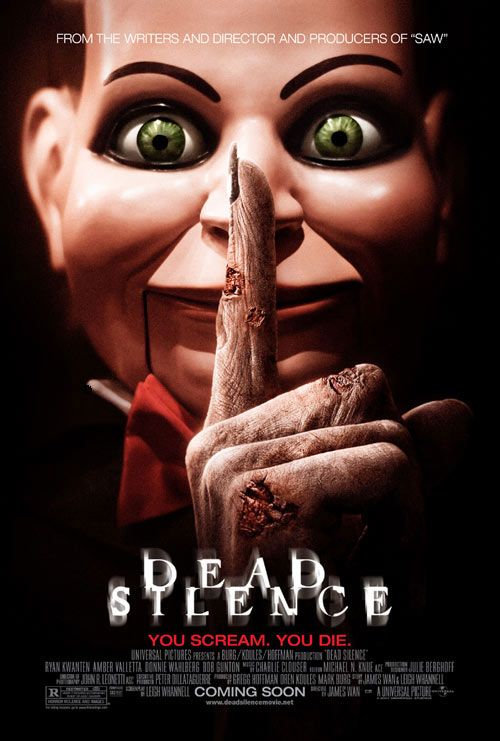
Dead Silence (2007) dir. James Wan


James Wan and Leigh Whannell have hit my horror sweet spot. Insidious (2010) provided the duo with a commercial success to distance them creatively from their earlier creation of the often maligned Saw franchise, but they'd developed an even bolder departure a few years earlier with their immediate follow-up to Saw (2004), Dead Silence. This film taps into a vein of retro horror that most modern filmmakers leave untouched: the extravagant, potentially corny, earnest shriek shows of the 1950s and earlier. Though updated for contemporary sensibilities in terms of its violence, editing, and cinematography, Dead Silence is virtually a hyperactive episode of The Twilight Zone mashed up against an EC horror comic. Its locations are moody and sound-stagy, giving the viewer the impression that the long abandoned sets of classic Hollywood horror were resurrected, having been twisted by time into even more expressionistic structures than they were before. The nursery rhyme mythology that the film creates for its villain, coupled with the story's frequent violations of mimetic narrative logic, hint that this is a film best suited for the fertile and accepting minds of a younger audience, eager to squeegee away such perceived flaws in favor of soaking up its excess of imaginative qualities. The film's R-rating implies either a miscalculation on Wan and Whannell's part or the inability of the MPAA to understand how desperately the thirteen-year-old crowd needs exposure to this sort of nightmare. They are, after all, our horrifying future.


The Watcher in the Woods (1980) dir. John Hough


A film I wish I'd peeped as a child, John Hough's Disney-produced The Watcher in the Woods was filmed shortly before he made The Incubus (1982) with John Cassavettes, a film about a demonic entity raping women to death. Though Hough had already made the fairly strange Witch Mountain films for Disney, the director of suggestive, sexually-charged films like Twins of Evil (1971), The Legend of Hell House (1973), and Dirty Mary, Crazy Larry (1974) is still a peculiar but welcome choice as a director of children's cinema. Appropriately, The Watcher in the Woods, adapted from a pretty odd-sounding 1976 young adult novel written by Florence Engel Randall, is more bizarre and frightening than anything I've yet seen from the house that Mickey built. One part Nancy Drew mystery and two parts alien-encounter-masquerading-as-a-haunted-forest trans-dimensional mini-epic, the film is-- even in its toned down theatrical version-- pretty wild. The studio's post-production tinkering with the film's ending has been well documented, but both of the alternate versions of the ending must be seen for the viewer to achieve a full understanding of the trippy, horrifying, head-scratching cosmic insanity the filmmakers were intending. Besides these joys, the film also presents young viewers with the positive role model of a brave, inquisitive, and independently-minded female protagonist in the character of amateur sleuth Jan Curtis (Lynn-Holly Johnson, in a performance that loosens Carroll Baker's usual stranglehold on the award for most wide-eyed overacting in whatever film she's starring in). If Disney had refrained from meddling with it in post, The Watcher in the Woods could have become a minor classic, terrifying and transporting the minds of its child audience to new planes of cinematic existence and possibility. As it exists, it's that sort of weird and confusing Disney movie half-remembered from many childhood VHS rentals.

Thursday, April 4, 2013

March 2013's Footstones

Being a List of the Assorted Horrors I've Consumed During the Month of March, 2013.


Absurd (Rosso sangue) (1981) dir. Joe D'Amato


Absurd is Joe D'Amato and George Eastman's quasi-sequel to their own Anthropophagus (1980). Though the former begins where the latter ends (with a disemboweled Eastman stumbling about), similarities cease immediately thereafter. Something is lost in retrofitting Anthropophagus' moody, often quiet, gore-leaking atmosphere into Absurd's bombastic, Halloween-ripping slasher tropes. It feels wrong to call Anthropophagus a subtle film (if we consider the fetus-munching and all), but in comparison with its successor it's unquestionably the film more willing to allow dread to breed in the viewer through a lack of action. Absurd tries a bit too hard to be an action-packed American slasher (of course it can't completely succeed: this one is Italian to the bone), and so feels more like a tightly assembled Greatest Hits package for the peaking subgenre. Fun, clever, and messy-- assuredly-- but because of its safe (if manic-paced) plumbing of conventionality, Absurd can only express a creative originality through slight twists on stock situations (of particular note is the superbly tense sequence in which a bed-ridden preteen girl must escape from her confining traction apparatus to evade Eastman). A decapitating finale cements my appreciation for the film, but it's fair to say my heart rests more with tortured, sun-blistered, gut-munching cannibals than lumbering, self-regenerating, bearded, wavy-maned night stalkers.


Deadtime Stories (1986) dir. Jeffrey Delman


Deadtime Stories is a horror anthology film that gives an intermittently mid-'80s approach to classic fairy tales, mushing tones and time periods together into an occasionally captivating jumble of stories and ideas that is in fact quite well summarized by casting a glance at that poster to your right. The film does indeed shove a mess of disparate elements down our throats, but despite the pained expression of the poor man in the poster it's not an entirely unpleasant viewing experience. A humorous wraparound about a drunken uncle regaling a sleepless child with sloppily told fairy tales bridges our three increasingly ridiculous segments together. Though perhaps an intentional progression, this devolution of the film into a full-fledged comedy as the uncle becomes restless and annoyed over having to tell yet another story is also a pretty big problem considering the overlong nature of the first segment (concerning some witches and their slave boy) and the fact that the strong sense of demented humor displayed in the final tale (a murderous riff on Goldilocks) leaves it feeling set apart from its more straight-faced peers. Nonetheless, Deadtime Stories is brief and diverting, with fantastic practical special effects throughout. My only true gripe is that the singular 1980s charm is restricted exclusively to the sadly forgettable second story (about a spunky, teenaged, color coordinated red sweater and pants-wearing Red Riding Hood who neglects to bring Grandmother her meds in favor of boinking her boyfriend in a shed) and the film's opening tune, which manages to namedrop Hitchcock, De Palma, and Romero in the same line, leading to comparisons between their work and itself which it should probably wish to avoid.


Sorority Babes in the Slimeball Bowl-o-Rama (1988) dir. David DeCoteau


Though far from what most sentient beings would refer to as "a good film," David DeCoteau's exquisitely titled Ghoulies-in-a-bowling-alley flick, Sorority Babes in the Slimeball Bowl-o-Rama, is irresistibly enjoyable. Reveling in sophomoric humor and barely competent lunacy, the film takes a largely predictable spin on the old maxim in re: monkey's paws and wish-granting genies: "Be careful what you wish for!" (Though the genie here is more accurately a foul-mouthed, trophy-dwelling imp puppet with a drunken operator.) Though there are moments of pleasing cartoon violence, the bad wishes instead generally result in some kinky sex comedy "eroticism" that allows for the rampant ogling of bosoms, buttressed by some early sorority hazing sadomasochism with a paddle and some rear ends. (A scene that's led one salivating Wikipedia writer to opine: "This proved to be one of the best spanking scenes in mainstream film and helped the film to become a cult favorite.") The star of the film is the incomparable Linnea Quigley as the nihilistic juvenile delinquent Spider, and she's perhaps never been better than here as she forms an unlikely platonic bond with the nerdy Calvin (Andras Jones) and sends the wicked imp back into the bowling trophy from which he sprung.


Black Candles (Los ritos sexuales del diablo) (1982) dir. José Ramón Larraz


While Larraz uses sleazy eroticism in films like The House That Vanished (1974) and Vampyres (1974) in service of his story and in the hope of producing Freudian psychosexual unease, Black Candles-- emerging nearly a decade later when the director had fewer opportunities for getting his films made-- is little more than satanic softcore with the revolting inclusion of a goat in its demon seeded orgies. The film brings erotic horror to new patience-testing lows, its gigantic shrug of a horror plot existing solely to occupy the screen in the bits between the dry humpings. Because the film is so totally uninterested in imparting any feeling or emotion through its copious erotic activity, we're left having to conclude that the film exists solely to titillate, and poorly at that. Authors Pete Tombs and Cathal Tohill report in their book Immoral Tales: European Sex and Horror Films, 1956-1984 that Larraz was embarrassed with the film, and it's not too taxing to discern why.


Boardinghouse (1982) dir. John Wintergate


Boardinghouse is an early shot-on-video horror film, and perhaps the most ambitious and cheekily demented of them all. Writer/director John Wintergate casts himself as Jim, a wealthy and perpetually shirtless landlord who rents the remainder of the rooms in his large house to a gaggle of likewise perpetually shirtless young women. The premise sets us up for a sleazier ego-driven affair than the film ultimately delivers, for which we can all remain grateful. While there's a smidgen of hanky panky, the bulk is devoted to odd spurts of cornball humor, perplexing early video effect-addled slasher killings, and supernatural ESP shenanigans falling somewhere just shy of Blood Beat (1983) on the insanity scale. Clocking in at a flabby-considering-the-paucity-of-story ninety-eight minutes, it's assured to grate on the patience of most viewers, but there's more than enough inventive weirdness for those willing to accept the faults and the decidedly amateurish sheen.


Dr. Jekyll & His Women (Docteur Jekyll et les femmes) (1982) dir. Walerian Borowczyk


Dr. Jekyll & His Women is the first film by Walerian Borowczyk I've had the pleasure of viewing, and it has fast made me anxious to devour the rest of his lengthy filmography. Though it significantly-- nearly explicitly (Hyde's giant prosthetic penis, I'm looking at you)-- amps up the sexual and sadomasochistic tendencies only latent in Robert Louis Stevenson's novel, what's incredible is how faithful Borowczyk's film is to the novel's presentation of the Jekyll/Hyde dynamic, if not the particulars of its plot. As in the novel, the sheer primal joy Jekyll feels at being able to transform into Hyde and let his id run wild by shirking his public face is the emphasis. To transform into the rape-happy Hyde, Borowczyk's Jekyll (the fabulous Udo Kier) must roll around in a tub full of blood-colored chemicals, and whenever he does so (which is, greedily, multiple times over the course of a single night) he appears to be at the height of orgasmic ecstasy. This Jekyll, like the novel's, is not at war with Hyde, but is Hyde. The film uses its isolated castle and overnight lodging party guests to reveal-- rightly so-- that Jekyll's condition isn't unique to him, and that perhaps we all have a Hyde within us that we're eager to set loose, if only we can discover some secret formula for evading the hypocritical pressures to behave that society places on us. (See: the General's (Patrick Magee) enthusiastic Hyde-like whipping of his sexually active daughter, and the willing curiosity of Jekyll's fiancee, Fanny Osbourne (Marina Pierro), to experience his chemical freedom and the violently emancipating actions she takes under its influence.) Borowczyk's visual style, replete with extreme closeups and discontinuous editing, is an intimate, claustrophobic marvel, and Dr. Jekyll & His Women is a mature and disturbing probe of the seedier, but perhaps more liberated, side of human nature. Expect to see some further words on this film here at the blog at some future date.


Silent Madness (1984) dir. Simon Nuchtern


One of the more tiresome slashers I've seen in some time. Silent Madness (in axe-flinging 3-D) makes the unconventional choice of mostly neglecting to spend any quality time with its sorority sister victims. Rather, the film centers on a pair of adults-- a medical psychologist and a local newspaper reporter-- who attempt to apprehend a neglectfully released homicidal lunatic in-between sessions of batting their eyelashes at each other. Loading a slasher film with mature protagonists is rarely a poor move, but placing them (for the majority of the film) out of direct peril sucks dry any immediate tension, the abundance of which is a dire necessity in a film in this mode, and the fact that spending so much time with them prevents us from getting to know-- much less distinguish between!-- the sorority sisters makes their inevitable deaths feel all the more perfunctory, as inspired as they might occasionally be. (See: a particularly gleeful-- and particularly '80s-- double homicide involving workout equipment and the arcade version of Dragon's Lair, in 3-D.) If the film has one thing going in its favor, it's an almost un-slasher-like subplot concerning the wild abuses of medical institutions that violate human rights while assuming authority of the management of hostile human bodies. But this queasy sci-fi tangent doesn't elevate the film: it instead leaves the film feeling more confused about what it aims to be. The film is no Hospital Massacre (1982) or Alone in the Dark (1982), both of which easily folded similar medical concerns into the slasher formula and became all the more thematically rich for them. Silent Madness is primarily rich in yawns.


The Uninvited (1944) dir. Lewis Allen


A puzzlingly well-regarded ghost yarn from the classic horror era, The Uninvited is brimming with much too much corny, folksy humor that deflates (one imagines unintentionally) all of the few horror bits, which barely register on the horror scale to begin with. At times the film more closely resembles a less-spirited (pun optional) foray into the contemporaneous romantic comedy genre, though with the perplexing distinction of the central couple being a brother and sister (Ray Milland and Ruth Hussey) cohabiting a (barely) haunted house. This romantic comedy tone becomes an issue when we notice that not even our protagonists are frightened by the ghost that appears every evening in their new abode. If they're not the slightest bit uneasy, how could we possibly be? The film concludes with Milland's character actually laughing and wagging a finger at the ghostly apparition in front of him until it vanishes in shame, back into the ether. The film's needlessly complicated plot doesn't help matters much either, as it serves to only confuse the viewer and dedicate much of her remaining attention to its fruitless unraveling. The architecture of the haunted seaside house is rendered in a mundane contemporary style, and while this is a refreshing move away from the Gothic tradition it's a choice let down by the bland and workmanlike cinematography, which never attempts to capture the eerie quality that even relatively modern domestic structures can possess in the dead of night.


Images (1972) dir. Robert Altman


Images is one of Robert Altman's least often seen and talked about films, probably because it's one of his least "Altmanesque." Weird to say, because the film features many of his already-fully-developed signature stylistic touches (overlapping dialogue, ambiguous plot points), but Images differs from its obvious descendant in Altman's filmography, 3 Women (1977), in that it's wrapped snugly around a conventional psychological thriller story and concludes rather neatly with a definite (and not unexpected) closing revelation concerning the psychological state and prior actions of its tortured protagonist (Susannah York). This results in the film occupying a peculiar place in '70s cinema: it's too weird for the bulk of the psychological thriller crowd, but also ultimately too ordinary for the arthouse filmgoers. I think the pat quality of its resolution and some of its symbolism (the film returns on numerous occasions to the protagonist assembling a jigsaw puzzle) distracts from the complex psychological portrait of York's character painted throughout the film: that of a woman at war with her own desires, a conflict creating fluctuating perceptions of the men in her life-- both those present and absent-- that terrify her and threaten to collapse her various lives and identities into one messy, unfathomable jumble. It's an often startling film, with an impeccable score and lush cinematography revealing the vast, isolating nature of the Irish countryside that abandons York among the rolling hills with nothing but her multiple selves for company.


The Seventh Victim (1943) dir. Mark Robson


The Seventh Victim was a revelatory film experience. Frankly, I hadn't previously imagined a cheap horror production from so early in the genre's life could have mined such philosophical and psychological depths to such devastating effect. It's the best of the Val Lewton RKO horror productions I've seen thus far (now that's an accomplishment), and, moreover, one of the best early Hollywood films I've encountered, period. Dripping with stark but softly lit black and white compositions and morose, sleepwalking performances, the film is a dejected, nihilistic, minor-key masterpiece. Regardless of her sparse screen time, Jean Brooks is a captivating stoic presence as the tragic and doomed Jacqueline, pursued as desperately by her own depression as by the sinister forces out to silence her. Even when stripped of its admittedly toothless primary horror element (the passive satanic cult, so easily swayed from its devilish beliefs by only the slightest bit of preaching) the film remains an undeniable-- if experimental and unfortunately neglected-- pinnacle of the genre, wallowing in the most mundane but paralyzing of horrors: that of continued existence.


I Walked with a Zombie (1943) dir. Jacques Tourneur


I Walked with a Zombie is another Lewton-produced horror classic with an atmosphere almost more oppressive and mournful than The Seventh Victim's. The entire film feels like a protracted funeral procession, from which none of the participants wish to depart. Despite being produced in the 1940s and being set in the Caribbean with a largely black supporting cast, the film manages to toe the fine line between exploitation of indigenous cultural beliefs for moody and atmospheric chills and respect for the genuine power those beliefs seem to carry. This balance is probably best observed in the towering, bug-eyed zombie guardian Carre-Four (Darby Jones), who we're allowed to perceive as unnerving before the revelation of his total benevolence. Better yet, the film unambiguously asserts that the villains here (though such a term is difficult to bandy about) are the white settlers who have used the voodoo religion of the natives foolishly and unthinkingly, producing an unnatural (if harmless) creature, an undead physical reminder of their sins that locks their family into a painful and destructive stasis from which they cannot escape, even as it rots them from the inside.

Monday, March 4, 2013

February 2013's Footstones

Being a List of the Assorted Horrors I've Consumed During the Month of February, 2013


Though quite the understatement, it would be fair to say that I watch a few more horror films in any given month than I find the time to cover here on the blog. I began the blog almost a year ago with the intention of it being a screening diary, in which I hoped to more or less write about every horror film I watched. This was almost immediately stifling: not only was I forcing myself to write a developed entry about everything I happened to see (no matter how difficult or uninteresting that task may have been), but this dictum actually began to persuade me against watching as many horror films as I generally do, knowing that if I watched fifty or so horror movies in a month I'd feel that nagging compulsion in the back of my mind to write about them. The switch to monthly themes in the last half year or so of this blog's life has both given the blog a novel organizing principle and liberated me from the its initial mission.

Nevertheless, this decision has prevented a wealth of good (and execrable) films that I've been watching from being included here on the blog, so from here on out I'm going to split the difference by presenting a new monthly feature called Footstones. These Footstone entries will be the first of every month and will be a collection of brief-ish capsule commentaries on those odds and ends that I've watched but that didn't fit the previous month's theme. With any luck, these entries will soothe my writerly conscience and provide you, gentle reader, with some bite-sized thoughts for mastication.

For more capsule-shaped reading fun, make sure to check out my freshly published Favorite Film Discoveries of 2012 list over at Rupert Pupkin Speaks.


Urban Legends: Final Cut (2000) dir. John Ottman


Jamie Blanks's Urban Legend (1998), with its adoption of a clever but never cloying metanarrative, adherence to the bombastic and ludicrous tenor of slashers past, and utilization of Rebecca Gayheart's massive hair, rests unquestionably in the top tier of post-Scream slashers. John Ottman's follow-up can't claim the same heights. It's a decent entertainment, featuring likeable enough characters and some moderately cute (though ultimately underdeveloped) methods for connecting this followup to the first film. But its insane jumps in logic and storytelling (moves which felt organic in the first film) here seem overly calculated, as if they're missing the wit they think they possess (see: most of the jokes, the twin twist). Moreover, its film school setting is about as nauseating and false as such fictional depictions tend to be (see: resources as good as any Hollywood production and Joey Lawrence on his cellphone calling up his Tinseltown connects). It sounds like a snub to say that the best part of Final Cut is its closing credits, but if you've seen the film you'll understand: oh, what it could have been! Though I can't remember any compulsion to see it at the time (which is nearly unthinkable considering my affection for the first film), this sequel was not a direct-to-video release. It received a genuine theatrical run and even made a profit, though it only wound up taking in about half of the business that Blanks's film did. Indeed, a second sequel, Urban Legends: Bloody Mary (2005), which breaks away from the series' slasher roots on a supernatural tangent (Hello, Mary Lou), was released direct-to-DVD. Maybe someday it will haunt my television set, but Final Cut didn't leave me champing at the bit for more.


Bait 3D (2012) dir. Kimble Rendall


Yet there was, to no surprise, much ch[o]mping in this Australian "Sharks in a Supermarket" flick. The concept does not stretch much further than that, nor would we want it to. (Though, a case could be made for it bravely venturing outside its comfort zone by also including a "Shark in a Parking Garage Beneath a Supermarket" subplot.) This is director Kimble Rendall's first film after careers in rock music and second-unit direction, and perhaps in consequence of this the film seems as if its been whittled from the creative hands of an entertainer rather than an artist or storyteller. It is, in a couple of words, idiotic fun. Bait 3D's melodramatic dialogue and broadly sketched characters often left me rolling in laughter. Admittedly, the shark action (the raison d'être for this sort of spectacle) is subpar, creating not a lick of genuine tension-- especially in contrast to another recent Australian shark attack flick, The Reef (2010)-- but one cannot help but admire the genuine enthusiasm with which the filmmakers approach their sublimely goofy scenario.


Shark Night 3D (2011) dir. David R. Ellis


I was quite thrilled with the insanity-fueled high Bait 3D had left me with, but I happened to be snowed in on this particular night so followed it up with this gem from the late, great schlockmeister David R. Ellis (helmer of the two best films in the Final Destination series, parts II and IV). The buzz I'd heard from folks upon its release was none too kind, with most harping on its neutered PG-13 style. But I wonder if those reviewers walked in biased because of the ludicrous pretense that PG-13 horror can never be good, because what's here (perhaps in spite of or maybe even because of its self-imposed restraint) is extremely entertaining. Such restraint forces the film to create appeal in its other aspects, which Shark Night does. The risk that runs with total gore freedom is dreck like Silent Night (2012) or even Piranha 3D (2010), the latter of which is a decent film but still rests on its "Gore is entertaining/funny, huh?" laurels and can't bother to be appealing otherwise. (Like, if this movie were made by the director of Silent Night the sharks would have slowly eaten Katharine McPhee's boobs for 10 minutes while Donal Logue poured beer on the wounds and belched.) Shark Night is blankly likeable characters doing silly things in a preposterous situation. I suppose a lot of its appeal for me is it's odd wholesomeness, which is a rare trait in the Grunge City that is '00s-'10s horror. I mean, just look at this. This is the kind of stupidity we need more of in this genre. The villains in Shark Night hate college kids so much that they decide to populate a salt-water lake with various species of sharks and feed said college kids to them so that they can then sell the footage they film of this chomping to the Discovery Channel for Shark Week. Fantastic.


Screamtime (1986) dir. Michael Armstrong & Stanley A. Long


First Maxim: Horror anthologies are intrinsically enjoyable viewing experiences-- a lousy segment or two won't prevent at least one of them from capturing your fancy. (Even the abysmal V/H/S (2012) managed not to disappoint on this count.) Second Maxim: British horror anthologies are best of all. (View all of the Amicus anthologies and then try to mount a counter-argument. You have been dared.) With these general truths in mind, I'm happy to report that Screamtime, a low-budget slasher-inflected British horror anthology from the mid-80s, is certainly a pleasure, if not particularly the strongest example of the form. Though its third and concluding segment (about some sentient killer garden gnomes) is a bit deficient in its execution, the first two segments (the first about the bloody family problems of a beleaguered Punch & Judy show proprietor; the second about a woman receiving disturbing visions of the future after moving into a new house) are excellent slices of thrill 'n' chill. The wraparound segment, about a couple of oafish thieves watching the pilfered segments on their VHS player only to find those segments' antagonists appear in reality, is as much of a flat note as it sounds, though it does provide us a brief but utterly tantalizing glimpse inside of a UK-based video store in the pre-Nasties 1980s. What we see: a veritable wonderland.


The Kindred (1987) dir. Stephen Carpenter & Jeffrey Obrow


The Kindred is one of the best (if not the best) low-budget/high concept/higher effort creature features ever forged, and it's a crime that it's not talked about more often. Part of the problem, one imagines, is its unfortunate relegated-to-VHS status, but allegedly Synapse Films has been formulating a long-gestating remedy to this issue that will hopefully come to pass one day soon. The Kindred boasts an elaborate pseudo-scientific premise that allows for much monster carnage, including (among its greatest hits) a tentacled creature living under the porch and a woman metamorphosing into a fish. The practical effects are as gooey as they are gorgeous, managing at times to be jaw-dropping in intensity and ambition. And the film doesn't settle for visual splendor alone: it also features a group of (relatively speaking) intelligent and mature scientist protagonists who are likeable enough that the film can't bring itself to kill them all. The Kindred is by the same writer/director team who, just a few years prior, assembled the wonderfully gory and grim college slasher The Dorm That Dripped Blood (1982). As good as that earlier film is, The Kindred is leaps and bounds better in formulation and execution, foreshadowing great future genre efforts from this duo that (sadly) never came.


House of Dark Shadows (1970) dir. Dan Curtis


Walking into Dan Curtis's colorful big-screen adaptation of his own daytime black and white soap opera without being at all familiar with the source material was, I'd read in countless reviews, a mistake. The film necessarily condenses plotlines that ran for months on end over countless hours on television, and because of such takes some rather abrupt and jarring narrative leaps. Turns out, I adored House of Dark Shadows specifically because of its refusal to hold my hand while shifting through its dense array of characters and motivations. An astute viewer will have little trouble reconciling all of the film's bits and pieces, and will soon thrill to its sumptuous atmospheric pleasures and its refusal to slacken its mad dash to its gory finish line. This is an American Gothic in the grand and garish Hammer style, and anyone who cherishes that sort of spectacle knows how rare a bird it is. Thank you, Tim Burton, for making this film and its sequel's digital video debuts possible.


Night of Dark Shadows (1971) dir. Dan Curtis


The second Dark Shadows film, Night of Dark Shadows, features the notable absence of first film and series' star, Jonathan Frid, as the vampire Barnabas Collins. It instead features some later Collins descendants at the old Collinwood estate, dealing with seductive ghosts and witches. This does not at all feel like a step down in quality. Unlike House of Dark Shadows, Night is leisurely paced, and that's actually a benefit to its much less visceral concerns. Its manifestations of its haunting are occasionally more subtle than its soap opera origins would lead you to assume, and all the more effective for it. (Of special note in this regard is its wonderful final sequence, which plays for both subtlety and bombast one after the other and pulls off both with class.) Simultaneously, its emphasis on documenting a decaying domestic relationship feels much more in line with typical soap opera subject matter than House's opulent vampire drama, and becomes (as soap operas tend to) rather engrossing over its hour and a half running time. (I'd love to see its long-lost extended cut, which is said to be fuller and more coherent, though I had no trouble at all following or appreciating what was left after the editor put down his scissors.) Night reminded me, in many ways both broad and specific, of a film director Dan Curtis would soon direct, the Oliver Reed and Karen Black haunted house drama Burnt Offerings (1976). Perhaps the later film was an attempt to right the wrongs perpetrated on the former in the editing room? In any case, Curtis provided us two of the very best American-produced haunted house films in only five years back in the 1970s, and that's no small feat.


Death Ship (1980) dir. Alvin Rakoff


Death Ship isn't as good as its poster, but then that's a tough image to live up to. Nonetheless, it's a decent maritime thriller with an imposing haunted Nazi warship as its primary location. George Kennedy is his usual fantastic self as a beyond-cantakerous retiring ship captain who, upon shipwreck and ghostly possession, takes command of the titular ship and sets his fellow survivors up for blood sacrifice. No matter how you cut it, a haunted ship that runs (figuratively if not actually) on human blood is pretty nifty, and if the Nazi angle adds an exploitative angle to it all, well, all the better for this sort of venture. There's some decent horrific imagery (like when one of out heroes falls into a watery cargo hold full of decaying corpses) alongside equally clunky ones (a bloody shower is treated by its screeching recipient as The Most Horrific Thing of All Time while we scratch our heads). To its credit, Death Ship also prominently features two young children among its cast, and their performances (along with a recurring joke about how the little boy has a clearly defective bladder) somehow didn't inspire me to thunk my head repeatedly against the wall whenever they were on screen. So, kudos. The recent blu-ray release of the film from Scorpion Releasing is a fine one, with a rather sharp transfer and some fun supplementary materials.


The Video Dead (1987) dir. Robert Scott


Excellent mindless trash. Its perplexing central conceit (a haunted television set bound for a paranormal research institute winds up in a suburban home and begins spawning vain, life-envying zombies) is so earnestly accepted by the film's characters that, in its own non-logic, we actually come to accept it. The Video Dead knows that it's funny-- most of the time, at least-- and when it doesn't, as in the case of lead actor Rocky Duvall's gee-whiz performance, it's delectable for reasons of amateurish gung-ho. Its wonderful final act, in which our heroine plays housekeeper and hostess to our confused zombie horde in order to avoid being attacked, feels as if it would fit comfortably in Peter Jackson's early genre work. The Video Dead was released for the first time on a digital format in February by Scream Factory as one half of a monsters-in-the-television-centric blu-ray double feature, the other half being the glorious and long-sought-after Terrorvision (1986). To call this the release of the month would be a gross understatement: seeing these neglected films so lovingly preserved and supplemented is enough to warm the cockles of the most jaded of genre fans' hearts.


The Nest (1988) dir. Terence H. Winkless


Another Scream Factory release from last month was Terence H. Winkless's mutant roach flick The Nest. Before a delay of this release, I had scheduled myself to cover it during January's Nature's Grave feature here at the blog. The film fits snugly into the confines of the Animal Terror genre, sporting all the distinguishing features: reckless scientists, mutated wildlife, unconcerned/complicit local authorities, and a half-baked ecological message. Among its peers, it's an unremarkable effort, despite some occasional flashes of Slugs-level gory brilliance and the presence of the ever-adorable Lisa Langlois (who also starred in the much superior but equally scrappy killer rat flick, Deadly Eyes (1982)). Perhaps the film's biggest issue is how little screentime the cockroaches actually have. For a film explicitly about the insect's ick factor, more could have been gained by keeping their physiology grounded in quasi-reality (or maybe taking the exaggerated Creepshow (1982) approach) rather than by promising flesh-eating mutant roaches (see the above poster) that it can't deliver. We're gifted some nifty looking cat-roach and human-roach hybrids, but it says something that the film's best squirm-producing moment is one in which our protagonist fails to notice the roach swimming around in his coffee cup.


The Night Stalker (1972) dir. John Llewellyn Moxey & The Night Strangler (1973) dir. Dan Curtis


More Dan Curtis goodness in the form of two television movies that spawned a later abbreviated series. Kolchak, a perpetually down-on-his-luck crack investigative reporter, is a fabulous character, and Darren McGavin plays him with all the easy underdog charm that's required and then some. Besides the fun creature plots (a bit more interesting in The Night Strangler, with its inverted Frankensteinian overtones), the most enjoyable aspect of the films is Kolchak's explosive friendship with his weaselly editor, Tony Vincenzo (Simon Oakland). The two are akin to an old bickering couple who can't seem to get rid of one another, despite the constant betrayals and disappointments. Considered together, the films are formulaic (they possess essentially identical plots, with different creatures and locations subbed in), but because it's such a satisfying formula it's difficult to complain about. (My understanding of the later Kolchak series is that it continues the basic formula established in these films, in essence creating the Monster of the Week plot adopted in-part by later series like The X-Files and Fringe.) My hope is to return to the world of Kolchak, and soon.