Showing posts with label comedy horror. Show all posts

Wednesday, May 28, 2014

Shepperton Screams (Part XVI): The Monster Club (1981) dir. Roy Ward Baker

For sixteen weeks, Jose Cruz of The Grim Reader and I will be delving into the complete horror filmography of Amicus Productions and regaling you with our spirited discussions. Below is our mutual consideration of a final anthology film produced by Amicus's Milton Subotsky, THE MONSTER CLUB (1981)

GR: Well. Here we are.

We’re in THE MONSTER CLUB (1981), to be precise, and oh boy is it the happenin’ place to be on a dark and chilly night when you got time to kill and want to share a drink with a fiend. The film is both the most and least appropriate to leave off on during a conversation concerning Amicus Studios. It has all the macabre, darkly witty qualities of the company’s former films, combining garish horror with a satirically pointed look at the very same conventions that they had built their reputation upon. Vampires leer with goofy fangs, creatures and critters dance with wild abandon, and a fellow who appears to be a Jewish werewolf comedian all lighten the air with their wink-wink, nudge-nudge mannerisms and hamminess. Its trio of terror tales is uniformly good to great, delivering solid thrills, innovative twists on old mainstays, and atmosphere as thick as London fog that would make any avid viewer’s black heart flutter.

It also brings a creative team together from the company’s old days that is swoon-worthy: a group of thespians including Vincent Price, John Carradine and Donald Pleasance; composer Douglas Gamley back at the bandstand; Roy Ward Baker (ASYLUM, AND NOW THE SCREAMING STARTS) directing; a script based on the short stories of R. Chetwynd-Hayes, the scribe who provided the sources for Amicus’ previous portmanteau FROM BEYOND THE GRAVE (1974); and even ol’ smiling Milton Subotsky is back as one the producers. THE MONSTER CLUB is in every way a triumph and a perfect swan song for Amicus.


Except it’s not an Amicus movie.

As you alluded to in your earlier post, THE MONSTER CLUB is in no way, shape, or form a product of Subotsky’s and Max Rosenberg’s brainchild, rather a joint picture made under the strange entities known as Chips Productions and Sword and Sorcery Productions. It’s very true that it brings back many of the company’s members for this little ghastly jamboree, but THE MONSTER CLUB is not in fact a card-carrying member of the studio that dripped blood. This is a point that undoubtedly surprises a lot of folks, because the film feels like the genuine package so much that it’s hard not to imagine it sitting amongst the shelves with DR. TERROR’S HOUSE OF HORRORS (1965) and TORTURE GARDEN (1967). And sure, if we had wanted to be sticklers about it, we could have excluded THE MONSTER CLUB and just ended this mini-blogathon with THE BEAST MUST DIE (1974). But, honestly, doesn’t that just sound depressing when you read it? THE MONSTER CLUB is truly an Amicus film in spirit, and that’s all that matters to me.


And in a way THE MONSTER CLUB points the way toward the new generation, namely in its wraparound segments, the vibrant life blood of youth coursing through the synthesized notes of the musical numbers that fuse punk and glam and Gothic into a heady mix that is just too good to resist. The headquarters of the eponymous society itself are sweeter than gargoyle lollipops (try them sometime), a pad that looks like it was hastily adorned with trappings from the nearest Spencer’s Gifts shop to make it look as “spooky” as possible, a set from a horror host’s program infused with a neon, late-night party atmosphere. It’s a glorious world that the vampire Eramus (Price) and his favorite author Chetwynd-Hayes (Carradine) reside in. Here is a place where the writer’s works, all in lurid paperback editions, are proudly displayed in a bookstore’s window. And not only do humans enjoy reading Chetwynd-Hayes’ shudder stories, but the monsters get a kick out of it too! This is a world where horror flourishes, a plane of existence that practically thrives on it and where everyone loves it unremittingly. When I die, I hope my soul goes to the disco spookhouse that is THE MONSTER CLUB, a place where I can strip my skin away to reveal the gyrating skeleton underneath or shake my booty in a rubber Halloween mask as I please.

I think you’re going to need to take it over from here. They’re playing my song…


NT: THE MONSTER CLUB is probably the only film in cinematic history bearing the credit of “Music by John Williams and UB40.” Oh, sure, the “John Williams” in question is an Australian guitarist, not the noted American composer, but the juxtaposition of the names and the associations they evoke is nonetheless appropriate: this final quasi-Amicus production is classic English horror of the ‘60s and ‘70s dressed up in the spandex and oversize blazers of the ‘80s. It’s a creaky Gothic castle redecorated as a punk rock club. The sight of old horror fogies like Vincent Price and John Carradine being given VIP treatment at a youth hot spot while electric guitars blare over the soundtrack proves that you’re right: this is an alternate world we’re visiting.

Each of THE MONSTER CLUB’s three segments (while maybe a touch goofier than usual) would have no real trouble fitting into the fold of any prior Amicus-produced anthology. However, one could not say this of the film’s wraparound segments, which mostly take place in the eponymous nightclub and could almost better be called “musical interludes.” The brightly hued, hip environs and patrons and upbeat, jocular tone of these segments is totally at odds with everything Amicus ever produced previous to this moment. This commingling of old storytelling sensibilities and glossy modern aesthetics is jarring, particularly because of the inability or disinterest on the part of Baker, Subotsky, Chetwynd-Hayes, et al. to blend these disparate parts into a unified whole. Instead, we’re provided with three typically pulpy Amicus horror tales punctuated by rock songs about vampire romance and weekend skeleton stripteases. I honestly don’t know what to make of it.


We could call it callous marketing. Perhaps the intention was to wrangle some final dollars out of the tired Amicus anthology formula by appealing to teenaged audiences through surface-deep appropriations of youth culture. Or, maybe the intention was to garner the interest of children through corny vampire humor. Without the checks and balances of his partnership with Max Rosenberg, Subotsky infects the film with an unadulterated strain of the childish glee and fascination with storybook monsters that we’ve endured previously in a more subdued fashion in the earlier anthologies. Third option: maybe what we see in the film is no more than these once-Amicus, now-ancient filmmakers following (or attempting to follow) the natural trends of horror in the 1980s towards the frivolous and excessive. Hell if I know. THE MONSTER CLUB feels at moments like all of these reasons and none of these reasons are responsible for its genesis.


Moreover, this confusion of intention produces a tonal inconsistency that throws into question our perception of every last thing we see on screen. Example: The many scenes of the titular rock club feature shots of sundry creatures in dime store Halloween masks who are bobbing and thrashing about to the tunes being played on stage, as if they populated a low-rent Mos Eisley Cantina. At no point is it made apparent to us whether or not we should be accepting those masks for the fleshy and furry faces of actual monsters. That’s the sort of diegetic limbo the film places us in throughout, somewhere between earnest worldbuilding and ludicrous spoof.

Re-watching the film has revealed to me that my feelings have cooled a bit since my last viewing. It’s a charming film, certainly, and (as I’ve touched on above) it’s uniquely bewildering, but it’s also pretty far from the best anthology that Amicus (or those persons directly related to Amicus) has to offer. As noted, tonal inconsistency is an issue, but worse yet is that the second segment (or, the entire middle section of the film) is utterly forgettable. (I should know; I’d forgotten it!) Still, THE MONSTER CLUB’s unmitigated juvenile enthusiasm for its subject matter carries it farther than you might expect. How can one quibble with the opening anthem’s declaration that “Monsters Rule, OK!”? Some things are obviously true.


GR: It’s too bad that George Pal had already called “Dibs!” on the title WHEN WORLDS COLLIDE (1951), because the dichotomy between the music video-jive of the wraparound segment and the hoary, Old World theatrics of the actual vignettes in THE MONSTER CLUB is pretty stunning. While Halloween-masked boogiers get funky on the dance floor, Eramus regales us with tales of shuttered misfit monsters, Borscht Belt bloodsuckers, and fog-shrouded ghoulery. Peanut butter and chocolate it most certainly is not, and yet I find it to be a delicious concoction nevertheless. Sure the two thematic worlds on presentation here could hardly be any more different to each other, but they’re both individually fun and full of their own special appeal that the big clanging noise they make when they run into each other is dulled by my overwhelming affection for each of them. Sometimes I think I’m much too loving for my own good.

Our first story, “The Shadmock,” introduced to us by way of head-scratching monster genealogy, is a rather delicate little sonata that plays up the pitiful poignancy of its main character before ratcheting up the gruesome terror for its crispy dénouement. Lovers Angela (Barbara Kellerman) and George (Simon Ward) catch wind that a local, rich hermit named Raven (James Laurenson, memorable for his sinister turn in the HAMMER HOUSE OF HORROR episode “Rude Awakening”) keeps all of his valuables and bundles of cash locked in his mansion’s safe. Sniffing prime bait for a little thievery, Angela tries laying on the charm when she applies for a general secretary/housekeeper position under Raven’s employ. However, the lady finds the gentleman’s appearance a little upsetting.


Raven is the poster child for reclusive oddballs. His skin is milky pale from prolonged periods spent indoors, his oily hair parted down the middle in choirboy fashion and the dark rings under his puppy dog eyes hinting at a restless and tortured soul. That’s because Raven is a shadmock, that most despised of bastardized monsters, a Looney Tunes caricature of creepiness fueled by an intense hunger for affection and acceptance. The shadmock, though, is not without his own set of fangs, except that his comes in the form of a banshee-like whistle, one that renders those who hear it into a pile of singed flesh.

The first segment of THE MONSTER CLUB is probably the film’s best and undoubtedly its most unique. One cannot confuse it for any of the other adapted stories from R. Chetwynd-Hayes’ Amicus resume, in this or the previous FROM BEYOND THE GRAVE (1974). It is perhaps most notable in its prevalent mood of loss and alienation. Any attempts at cheap shocks or cheesy humor are (mostly) dispelled in favor of painting a somber portrait of Laurenson’s character. In some ways this first story makes THE MONSTER CLUB feel more legitimate because it takes the time to study Raven’s monstrousness directly rather than superficially exploit it. It is the very fundamental difference between Raven and the other characters that serves as the story’s focal point. What is it that makes someone a monster? Is it an outwardly grotesque appearance? The potential or inclination to harm? Can a monster ever truly feel and, more importantly, find love?


We see that the shadmock is even an outcast amongst his own kind. During a masquerade, Raven’s fellow beasts effortlessly glide around the ballroom while he stands off to the side, a lonely island unto himself. While the other creatures here all wear similar masks, Raven’s opaque façade is especially indicative of his rank in their dark society. He is the plain, the unwanted, the unremarkable. His desperation is sharply illustrated for us when he comes upon Angela in the very act of pilfering his riches. In Raven there is neither rage nor even hurt at this betrayal occurring right before his eyes—the typical reaction of a wronged demon in this sort of story.

Instead he willingly tells Angela to take whatever treasures she wants… so long as he is able to hold on to her and have her love. It’s sickeningly sad, and the woman’s disgusted rebuke stings bitterly. Our hearts can’t help but go out to Raven as he emits his piercing whistle, tears brimming in his eyes. This is not an act of wanton vengeance. It’s pure, raw hurt. The image of the charred Angela advancing on George that caps off the story loses a bit of its punch because of this, but in the end it doesn’t really matter. The episode’s truly devastating moment has already come to pass.


The next story is “The Vampires.” Talk about your highs and lows. Now, I don’t necessarily hate “The Vampires,” but as my family has a fondness for saying about meals that didn’t particularly wow them: “Well, you don’t have to make this for me again.” That may be a little harsher than what I really feel, but the company that the second vignette keeps with its two bookending tales can’t help but make its charms feel diminutive in comparison. Which is honestly something that I hate doing with anthology films: basing the value of one story on how it stacks up against the others. So let’s try to look “The Vampires” right in its puss and call it out for what it is.

The story, for what it’s worth, mainly concerns a young boy named Lintom Busotsky (Warren Saire, and no points for figuring out the anagram) whose father (Richard Johnson) is a creature of the night straight off the boat from the old country. Lintom himself is constantly teased at school—palely shadowing the estrangement theme from “The Shadmock”—not because he is also a genuine Nosfertau, surprisingly enough, but just for being a lanky loser in general. And yet these playground taunts are evidence enough for one Mr. Pickering (Donald Pleasance) to recognize the boy’s allegiance with the undead. Eventually the man gains the child’s trust and makes a house call one day along with some of his associates, proving to the lad that his parents were right to warn him about “men carrying violin cases.”


The most unfortunate thing about “The Vampires” is that it feels like a retread back into the old Amicus days when they tried to inject blatant shtick into their tales of horror. Or, “The Dreaded Days of the VAULT” as they’re still known amongst the villagers. We get more goofy eye-teeth here ala “The Cloak” segment from THE HOUSE THAT DRIPPED BLOOD (1970) and Johnson goes all out as he puts on his Bela-in-the-opera-cape act for our “amusement.” It can get to be some pretty tedious stuff, all of which reaches its patience-trying apex in the tale’s climax when the vampire father reveals that he was wearing a “stake-proof vest” and a ketchup packet the whole time. To quote Johnson’s rabbi: “Oy vey!” This blatant fangfoolery deadens any potential impression that the story could leave upon our minds. To allude to an earlier comparison you made, this humor is generally not clever or innovative but rather as tired as an old, rubber chicken, thus cementing its status as generally forgettable.

There are some bits that work though. I was actually chuckling out loud when the two B-Squad members carry out the vampified and now-slain Pickering to their van, the solemn funeral dirge skipping in its track as one of the men tries to kick an errantly swinging gate door open and the long stake jutting out of the corpse’s body grinding against the floor of the vehicle as they stuff it into the back. But as you say, it’s all fairly unmemorable and were it not for the few titters it elicits from the audience it might have been hardly worth mentioning.


But let’s give three cheers to the final selection for bringing our spirits back up. “The Ghouls” does not attempt to look at monstrosity with a poetic eye or give it a jovial poke in its ribs like the two preceding tales but rather chooses to exist as a pure and wholesome example of the Saturday night creature feature. Which is to say it’s oodles of good, creepy fun. Sam (Stuart Whitman), a film director in the process of shooting his latest horror picture, decides to do some location scouting to find the perfect patch of decrepit land to serve as the backdrop to his dreary drama. And that he certainly finds in the out-of-the-way town of Loughville (see above for “no points”), a rotting hamlet just off the highway and equipped with its very own insular, rolling fog. Once there he is accosted by a skeevy, wild-haired innkeeper named Patrick Magee, his helpful and winsome daughter Luna (Lesley Dunlop), and a whole pack of rabid inhabitants who would like to have him over for dinner.

It’s nothing earth-shattering, but what I was most surprised by in re-watching this particular segment is how it breaks free of the limiting shackles that are inherent in the anthology format to become a kind of mini-movie in its own right. Once Whitman eludes the fetid claws of the hungry horde for the first time and holes up in the crumbling church with his female companion, “The Ghouls” begins to take on a slightly grander scale, echoing the type of siege pictures that genre pioneers Carpenter and Romero made so famous.


This makes “The Ghouls” both a call back to simpler horrors and an appropriation of contemporaneous genre movies all in one. On one side we have the ravenous ghouls hurling stones and cursing at our human hero, on the other the rough and tumble Whitman warding off his pursuers with a gilded crucifix. The story even has a neat bit of video game-esque worldbuilding when Whitman discovers a diary amongst the skeletal remains of the town priest chronicling the progressive invasion of the ghoul-people, complete with vivid illustrations in the style of Bernie Wrightson that paint the monsters in a more fantastic light than the dirty vagabonds that make up the murderous mob in reality. It all makes for a fairly invigorating experience, one that is punctuated by notes of both melancholy and that dark irony that short horror tales thrive on.

Ahh, I’ve become tired from my trademark wordiness yet again. I think I’ll leave the final estimation of this film in your reliable claws. I shall acquaint myself with a blood martini and listen to the next band’s set. I hear they have a killer groove.

But before I go I feel it is appropriate to raise a toast. Here’s to your tireless efforts, my friend, and here’s to the house that was Amicus.


NT: Once again, I fear you’ve unearthed my coffin-brain and scooped the exact thought and word content onto your plate, at least with regard to what I felt needed to be said about this particular picture. Well, perhaps you’ve only scooped out nearly all of my words. Like the noble Humegoo, I’ll make use of whichever dangling nouns and verbs are left in my ravaged neural network while attempting to offer some closing thoughts on these segments and the film in total. Pardon Humegoo inarticulateness. Here me go.

I think your reading of “The Shadmock” is on point. It’s the most emotional and affecting tale to come out of a Subotsky production, and it ranks as my favorite sub-half hour slice of horror we’ve discussed over these past few months. Essentially a whistling-monster infused reimagining of DAYS OF HEAVEN (1978) in miniature, “The Shadmock” forces us to confront our notion of the monstrous in a way similar to how the earlier film encouraged us to reevaluate our conception of the archetypal heroic young lovers. Despite his sickly pallor, unflattering hairstyle, and combustible whistling, can we in truth call Raven a monster? Or is his monstrousness a result of his society’s labeling of him as a monster, for reasons difficult to put into words? Moreover, wouldn’t it be more appropriate to classify the callous, indifferent couple, Angela and George, as the real monsters of this piece? What makes Raven a monster in this world is his loneliness and his desperation for human (or monster) connection. The merciless nature of those around him (even the damned cat is without pity!) makes of Raven a curious, repugnant creature by contrast. To desire love, above all earthly things? Aaagh!


Though perhaps I’m a monster, too, because I couldn’t help but get a kick out of the abrupt cut the film makes from a close-up of Raven’s anguished face to a close-up of B. A. Robertson’s face snarling out the first few lines of a rock song (“Sucker for Your Love”) back at the Monster Club. No time to wallow: the party must go on. (And to note: Robertson’s twitchy performance of this ditty, filmed for its duration in that extreme facial close-up, is among my favorite moments in the film. I like to think his performance is belying the early stages of a transformation into one breed of beast or another.)

Moving on, I’ll take a pass on “The Vampire.” In my family, we have the saying “If you can’t say anything nice, make sure he isn’t wearing stake-proof vest.”


Unsurprisingly, I’m also in agreement with you on the merits of “The Ghouls.” It’s a fine segment for us to go out on, and—as is par for the course with Amicus/Subotsky—it’s as ridiculous as it is genuinely suspenseful. (As you mention, the villagers in their tattered rags and bluish complexions are a peculiarly ramshackle vision of ghoulishness. Or, as Eramus would explain, “smaller budget.”) You’ve singled out my favorite aspect of the episode by mentioning the storybook history lesson of Loughville: I found those Wrightson-esque visualizations of the ghouls to be more horrid than anything Amicus has ever given us. Initially, I was surprised to find myself being so drawn into the ghastly static narrative of this story within a story, but the terrifying power of those lined faces and limbs—doing things as innocuous as dancing or peeking out from the bed covers—repulsed me in a way the main narrative’s moving images never could. (More evidence for the power of oral and visual storytelling, right?) This brief tangent within “The Ghouls” reads a little like a Lovecraftian tale of fiendish human degeneration, and that type of story never fails to set my skin a’crawling.


After all of the above has transpired, we wind up back at the Monster Club, and we watch as Vincent Price dances and claps out of time at the front of the stage upon which The Pretty Things play some English faux-reggae. This is after he has given a long, impassioned, winking speech to the assembled creatures of the night, arguing for humanity rightful place in the ranks of monsterdom (because of all the war, genocide, and assorted murders committed by humans, you see…). This is an appropriate end to our Amicus journey. Amicus was at times ahead of the curve in the horror business, at most other times behind, and sometimes so far off the curve its point failed to register on the graph. Their productions were at times deathly serious and at times were presented with a tongue so firmly planted in cheek they risked choking on it as it slipped down their throat. Amicus tried just about everything, to varying levels of success, during its short tenure in horror cinema, and that rambunctiousness has earned my appreciation (and I’m certain it has earned yours, too). Their films were perhaps never great, but they were always game, and they were—without (much) pretension—never embarrassed to be making the sort of horror they were making, whatever its negligible artistic value. The Amicus films were, in a sense, like Vincent Price dancing to reggae. We love them an offal lot.


Thursday, October 31, 2013

Trick or Treats (1982) dir. Gary Graver

Logline: Linda (Jacqueline Giroux), a struggling actress and part-time babysitter, takes an assignment on Halloween night that has her looking after the obnoxious, prank-pulling brat (Chris Graver) of two stage magicians. Coincidentally, the boy's biological father, Malcolm (Peter Jason), a wrongly committed mental patient, happens to break out of his confinement on the very same night and start his long, sexually ambiguous trek home to achieve his revenge.

Crime in the Past: A woman has her grumpy husband committed to an insane asylum over breakfast, because apparently this is a thing that you can do.

Bodycount: A mere 3 reasons to treat in fear of trick reprisals.

Themes/Moral Code: A moral message as old as Aesop and less clever than The Muppets, and even then the film doesn't take the time to develop it into a consistent variation on a theme, after no less than having the protagonist explicitly reference and retell the damn fable on screen. Sophisticated this is not.

A sub-theme: stepdads suck. A second: babysitting sucks. A third: children are inherently evil. This last one I concur with.

Killer's Motivation: Poor Malcolm. Enjoying your breakfast you were until your wicked wife, Joan (Carrie Snodgress), sicked those straight-jacket wielding orderlies on you, engaging you in a poolside tussle that nearly rivals a certain legendary alleyway tussle in its protraction. You spent the next four years in a psych ward for seemingly no reason at all while your wife went on to become a famous stage magician and marry a lecherous David Carradine, who would go on to raise your rotund, insufferable progeny as his own. Fed up at this injustice, you will plan and scheme. You will, on Halloween night, choke out a nurse and steal her uniform to escape your mental prison. You will walk the streets in this outfit and be propositioned by bums and sleazy suited drunks alike, despite the fact that you are an overweight middle-aged man in a dress. You will not take kindly to this, though it opens up potential doors of identity to you that you never knew were unlocked. (Yes, you can be beautiful.) You will eventually threaten a drunken Paul Bartel and steal his clothing. From there, you will continue on your journey home to your wife, murdering a woman who maybe sorta looks like her on the way before realizing your mistake. You will finally arrive. You will break into your own house, which you missed so dearly all this time, and stalk around, eventually seeing who you think is your wife but is in actuality the babysitter dressed up in her nightgown for reasons entirely plot-driven. You will chase her, for awhile, and in return you will be guillotined by her and your own son. This is your life, Malcolm. There is nothing one can do to make it poetic.

Final Girl: Linda the babysitting actress ain't bad, as far as these things go. She's career-driven, independent enough to refuse her boyfriend's every request, and always willing to speak her mind (as in the case of telling her young charge's mother what a rotten prick he is over the phone). But, boy, is she gullible. Every fake suicide and scare tactic performed by the boy she's babysitting sends her into wailing and flailing hysterics. And, because this happens nearly twenty times over a single evening, we begin to question whether this was adapted from the Extended 12'' Mix of "The Boy Who Cried Wolf" or if Linda's memory for traumatic frights extends only as far as one trip around the circumference of the fishbowl.

Evaluation: The tagline on the above poster for Gary Graver's Trick or Treats attests to there still being truth in advertising, at least as recently as 1982. An abysmal excuse to highlight the director's husky son pulling off some amateur magician fake-outs while copping a 'tude as the other performers grin and bear it*, the film is what one with a grievous head injury might mistakenly label "a comedy." It is, rather, a spoof so dimwitted that its dubiously humorous intentions double back and devour themselves, creating an ouroboros of candy corn-infused inanity. In one critical scene of meta-reflection, a pair of female film editors congratulate themselves for being true artists in their efforts to salvage a barely salvageable horror movie in the editing room. What we're allowed to glimpse of this resuscitated film involves Dracula in the midst of creating Frankenstein's monster and instructing his two female assistants to "give [him] head!" This is anti-irony. Unsurprisingly, director Gary Graver's filmography is littered primarily by pornographic films, a large number of them being early '90s porn parodies of then-current blockbusters, the best titles of which are Cape Rear (1992) and the Joi Fuck Club (1993). Trick or Treats, an ostensibly legitimate filmmaking effort, boasts in its credits that Orson Welles served as "Magical Advisor." Unfortunately, he never advised the film to disappear.

*The film's only stellar performance belongs to the great Steve Railsback, who (literally) phones in his role as the heroine's high-energy boyfriend preparing for his debut on stage in the role of Othello. He knows he's a little young to be playing Othello, he tells her as he aimlessly swings around his wooden sword, but he can always drop the pitch of his voice, he says, demonstrating his finest Eeyore impression, in order to acquire the requisite gravitas.

Monday, September 9, 2013

WNUF Halloween Special (2013) dir. Chris LaMartina

Logline: Halloween, 1987: Local television station WNUF sent a field reporter and a team of experts into the abandoned Webber House, site of the horrific Spirit Board Murders several decades prior, to broadcast a live television special that would confirm or put to rest the ceaseless rumors of the house's alleged haunting. The reporter and his team were never seen again. The television special presented to you is exactly what hit the airwaves on 10/31/1987, unedited and salvaged from the recycling bin of time.

A nostalgia project with an uncommon quaintness in its approach to reconstructing wistful approximations of yesteryear, the WNUF Halloween Special is also an aesthetic artifact of a cultural practice that's been lost to lossless encodes and streaming media in the cloud: the film is (at the moment) only available as a limited edition VHS tape, scribbled on with a felt tip marker and then shoved into an unadorned sleeve, as if it had been recorded off the television screen by a fellow discerning viewer as it aired and then exchanged discretely among like-minded friends or mailed to your doorstep through the machinations of some illicit underground bootleg service. Degraded, snowed-out magnetic tape recordings of television broadcasts (be they movies, television programs, marathons, or specials) were, for those of us who were children in the years before commercial home video became an affordable obsession, the stuff we were weaned on. Perhaps the most admirable quality of Chris LaMartina's faux found footage film is its devotion to recreating that singular viewing experience, annoyances and all, down to the commercial interruptions every couple minutes, irritating station call letter jingles, and that ad for the carpet warehouse that seems to never stop running. Considering the fact that these commercials make up the bulk of the film's length, it's to the filmmakers' credit that they're never a chore to watch and that-- barring a few promos for obviously nonexistent syndicated '80s TV series-- they rarely violate the appearance of verisimilitude. (Having fed her the phony story of the special's history and left off the fact of its more recent vintage, my partner discerned that the bloody special itself was staged but failed to suspect that it wasn't a genuine article of 1980s television.) 

Necessarily, the plot of the WNUF Halloween Special is secondary to the experience itself. As the tape rolls, we're greeted at first by a pair of cloyingly bubbly news anchors in costume on that specialist of days in 1987. This insipid, charmingly hokey duo introduce a few local interest pieces with holiday twists (like that of a local dentist who's running a candy buyback program) while teasing the start of the titular WNUF Halloween Special, which will see brash reporter Frank Stewart (Paul Fahrenkopf) and a team of paranormal investigators enter an allegedly haunted house in the hope of discovering the truth about its ghostly rumors. (An inspiration for LaMartina and his collaborators may have been the excellent Morton Downey Jr.-starring episode of Tales from the Crypt, "Television Terror," which bears a remarkably similar plot and also partially employs the found footage medium to tell its tale.) WNUF doesn't work as a film, but why should it? Was your town's local holiday news special ever worthy of the multiplexes? The moments in the film that most find their mark are those in which the ornery Frank Stewart interviews the assembled costumed audience for some unintentionally awkward local flavor. It feels trite to say, but WNUF succeeds in reminding us of, if not a simpler time, a slightly more innocent time in American history, when-- as various pretend commercials remind us-- we encouraged grown men to be big buddies to small boys, the Twins Towers still stood, and the biggest evil that the religious right saw itself fit to combat was the pagan ritual of one dark night in October. It's Ghostwatch (1992) for us Yanks, but-- unlike that artfully executed primetime ruse-- it's less attempting to play a trick on us than it is reassuring us that it loves our childhood, too.

Friday, August 23, 2013

Meltdown 09: Yellow Days of Summer (Part II)


Body Puzzle 

(Misteria

(1992) 

dir. Lamberto Bava


They're never the best of the lot, but it feels wrong to ignore a giallo from Lamberto Bava whenever one watches a whole pile of them in a row. Although they were all produced a decade or more after the subgenre had peaked, there's still something quintessential about his giallo films, or at least quintessentially '80s European horror about them, meaning they're cheaper, gorier, frillier, and more colorful and garish than their forefathers. From A Blade in the Dark (1983) to Delirium: Photos of Gioia (987), Lamberto's gialli forgo subtlety and style in favor of big blades and bigger hair. As the great Mario Bava's talent-challenged son, Lamberto chooses to overcompensate for his lack of cinematographic grace in all of his directorial efforts by piling on the decade-specific sleaze and cheese. And as in the cases of the two films mentioned above, this overabundance can be a lot of fun, as his gialli often border on a sensibility close to that of the frenetic insanity of his biggest horror hit, Demons (1985). But I have to suppose that by the early '90s, after several years of cranking out mostly Italian TV features, Bava had begun to mellow out. Body Puzzle, his chief giallo of the period, is an almost restrained effort, barring the inclusion of a few pieces of inspired lunacy (like a toilet bowl cam that watches from underwater as a severed hand plops down into the bowl, or when the snarling killer pops out from the interior of an icebox full of cubes and corpses). Through its restraint alone the film winds up tonally and aesthetically closer to the traditional gialli of the '70s than Bava had ever come before, and the result is a curious change of pace. Following the Columbo formula, we're presented early on with a killer (François Montagut) who listens to classical music through earbuds while he harvests donated organs from his assorted victims for conspicuous placement around the house of the recently widowed Tracy (Joanna Pacula), and it's up to the efforts of a dedicated police inspector (Thomas Arana) to unravel why. Many convoluted revelations concerning identity, sexuality, and vital statistics follow, along with some cameos from nearly unrecognizable older versions of Erika Blanc and Gianni Garko. Its constant, running-length-stretching plot twists and contortions keep the proceedings involving, but it's both amusing and beguiling to watch Lamberto play-- even fleetingly-- at building a classy production. I mean, consider who we're talking about here.


In the Eye of the Hurricane 

(El ojo del huracán

(1971) 

dir. José María Forqué


In the Eye of the Hurricane is a very Jean Sorel sort of film. It's an erotic thriller in the Diabolique mode concerning a handsome playboy who slyly plots the torment and hopeful death of a wealthy woman that he's romantically involved with in order to gain access to her vast funds. So, it's a lot like some of Sorel's other gialli: Parnoia (1970, written about below) and The Sweet Body of Deborah (1968), in particular. As luck would have it, Sorel happens to star in this enthralling Spanish-Italian co-production too (hooray for type-casting!). I won't deny that I'm a sucker for this type of giallo, as I've found that much joy can be wrung out of the games of domestic treachery and double-crosses even when they're not all that creative in their respective approaches or implementations. But In the Eye of the Hurricane, I'll hazard to argue, holds a dagger of originality up to the sub-subgenre's throat and dares it to make a clever move, resulting in a film that's both more suspenseful and ultimately more satisfying than its formal typicality would initially suggest. 

In this type of giallo, the female protagonist is generally beleaguered and hysterical, driven to madness, beset by paranoia, and left without much hope of saving herself from her own predicament without outside aid. In contrast, In the Eye of the Labyrinth's leading lady, Ruth (Analía Gadé), overhears the unambiguous late-night scheming of her envious ex-husband (Tony Kendall) and her sexy yet duplicitous new boypal (Jean Sorel, naturally) about halfway through, and thus she uses this secret knowledge to shape the events that follow. We spend the rest of the movie observing Ruth's emotional waffling between silent heartbreak over her beloved's betrayal and her cool determination to foil the plans against her before her danged brake fluid is tampered with again. (This waffling isn't always graceful, but it is always enjoyable to watch: in one scene, Ruth pretends to lay asleep and bizarrely resigns herself to death while Sorel's character stands behind her and points a gun at her head, unaware of her cognizance of his presence and intention. The editing in this scene hits a fever pitch as it quickly cuts back and forth between extreme close-ups of their anguished faces waiting far too long for something to happen before it finally does: the bedside phone rings.) Our uncertainty about which perspective Ruth will ultimately align herself with (revenge or resignation) makes the last act (which mirrors Carroll Baker's blackmail home imprisonment at the hands of two nymphomaniacal siblings in Umberto Lenzi's Orgasmo (1969)) a riveting watch as Sorel sneers, a crazed Rosanna Yanni snarls, and the sexual torment commences. Without divulging too many details of the wrap-up, it should be noted that Ruth is a complex and capable female protagonist-- independent, strong-willed, and essentially faultless-- and these qualities alone set the film that rises up around her apart from the pack and their parades of tragic or guilty women. All this, plus a scene in which Sorel and Gadé perform an upside Spider-Man kiss on the beach while rubbing each other's tummies. This corpse is exquisite.


Everybody Deceased... Except the Dead 

(Tutti defunti... tranne i morti

(1977) 

dir. Pupi Avati


It's not an arduous task to place myself back into the frame of mind that once thought, "A giallo spoof from the director of one of the subgenre's finest entries (The House with Laughing Windows (1976))? How could this viewing experience possibly go awry?" But, as I was reminded of after watching Everybody Deceased... Except the Dead, one should probably never underestimate the enigma that is 1970s Italian comedy: it will always find new horrendous ways to baffle and repel. We are, after all, speaking of the cinematic output of a country whose horror-thrillers even end, from time to time, on the high note of an anal rape gag (see: Andrea Bianchi's uber-sleazy Strip Nude for Your Killer (1975)). Commercial Italian films of the period were in no way subtle or refined, and the comedies even less so. If you haven't seen any but would like a general idea of how they feel, then imagine the general tasteless tomfoolery of a Screwballs (1983), a Joysticks (1983), or any other lewd and crude American teen sex comedy of the '80s and then skew that exact same content towards a middle-aged audience rather than post-pubescent teens. So, in short: jokes about masturbation, loose women, the mentally-handicapped, little people, homosexuality, cowboys, and... book salesmen. The story concerns just such a bulbous-nosed book salesman (Carlo Delle Piane) who arrives at the Zanotti family mansion on the eve of their patriarch's funeral in order to sell that collected bunch of eccentrics and perverts a reproduction of an old manuscript detailing the finer points of their family curse and a prophecy promising treasure if nine corpses are accumulated over the course of one stormy night. One member of the household, seeing this prophecy, decides to don a fedora and black gloves in the hope of speeding fate along. Hilarity ensues? 

There are certainly some good jokes to be found in-between all the groan-worthy nonsense: I quite liked the exchange between a confused victim and his killer immediately after the latter has stabbed the former in his side: "What's that?" "A nice stab, can't you see?" "(groans, dies.)" The film contains a few of the warm, fuzzy Old Dark House laughs that you'll receive from watching similar yet superior slapstick murder mysteries like Clue (1987) and Murder By Death (1976). For example, when the power is cut by the killer, the perpetually clueless Inspector Martini (Gianni Cavina) shouts at the others assembled, "pay the bills, guys!" (when the lights flicker back on later in the film, he sighs, with relief, "so they paid it!"). The film's most amusing gag occurs when the gathered family members, led by Inspector Martini, attempt to instruct a pair of dogs to follow the killer's scent from one of his victim's severed hands that they've discovered. They toss the bloody hand to the dogs, who then promptly devour it. There's clearly something amusing about the giallo murder mystery ripe for skewering, but  Everybody Deceased... Except the Dead's parody is far from as focused as it ought to be. When's the last time you saw a giallo that featured death-by-electric anti-masturbation machine?


Kill the Fatted Calf and Roast It

(Uccidete il vitello grasso e arrostitelo

(1971) 

dir. Salvatore Samperi


Salvatore Samperi's ultra-rare and ever-so-excellent Kill the Fatted Calf and Roast It deserves a wider audience, for its peculiar cinematic tale would satisfy genre junky and art film connoisseur alike. Far from a straight-razor wielding giallo, the film has as much in common with one of Poe's darkly humorous Gothic family tragedies as it does the more eccentric, atypical products of the subgenre it has been lumped in with due to historical proximity. This sad but inevitable tale of the doomed Merlo family, who are plagued by ancestral madness, Oedipal complexes, incestual lust, and sibling backstabbing, holds artistic pretensions that would place it in line with the demented, sexually-malformed social commentaries of Samperi's compatriot Pier Paolo Pasolini. The film not-so-subtly posits that Italy's rich old families, who have built their vast ancient wealth on the destruction and murder of whole villages of those less fortunate than them, are diseased at the root and fated to poison themselves through desire and aggression turned back on itself now that there's no one left to subjugate. After the unexpected death (or murder?) of the family patriarch, youngest son Enrico (Maurizio Degli Esposti) begins an investigation that places his shady older brother Cesare (Jean Sorel, making his second appearance today) and his dryly seductive cousin Verde (Marilù Tolo) as the primary suspects. At the same time, Enrico also busies himself with creating a creepy shrine for his insane dead mother and carrying on an illicit affair of motherly affection with his cousin Verde, who has sex with him but also dresses in his mother's clothes before offering him her breast to suckle. Sublime, surreal Freudian weirdness runs high throughout: it's the sort of film that inspires one to jot down a note reading "boob/pudding jiggle juxtaposition." Eventually, Enrico wades deep enough into his family's deadly business that he begins to drown, forcibly. The film submits through its title and some internal dialogue that in this way Enrico is like an innocent calf among hungry wolves, but it also becomes clear through Enrico's damaged psyche and the story's grim conclusion that a calf too long among wolves grows sharp teeth.


Death on the Fourposter 

(Sexy PartyDelitto allo specchio

(1964) 

dir. Jean Josipovici


An Italian-French co-production, Death on the Fourposter (also known by the less striking title Sexy Party) arrived in cinemas the same year as Mario Bava's Blood and Black Lace (1964), a film of no small importance to the foundation of the giallo subgenre. Consequently, director Jean Josopovici's film doesn't have an ingrained giallo tradition to draw upon when concocting its own murder mystery, and so instead draws upon elements of the Gothic. And yet, those elements of the Gothic that Death on the Fourposter employs-- seances and mediums, chilly castles, returns from the dead-- would soon become as much a part of the giallo tradition as Bava's fashion models and gloved killer. This observation is not intended to give Death on the Fourposter (which is, after all, a rather obscure film) equal or even a significant amount of credit in the development of the subgenre, but it does make clear that Bava's film didn't appear out of the ether: it, like Jean Josipovici's film, was the product of an evolution of a long and storied tradition of murder mystery and Gothic horror cinema in Italy and throughout Europe. That these and other Euro mystery films were, by the mid-1960s, simultaneously beginning to include scenes of more blatant sexuality and bloody violence than those films of previous decades is a sign of the fast-changing times post-watershed horrors like Psycho (1960) and Peeping Tom (1960).

Through almost entirely deficient on the bloody violence count, Death on the Fourposter's proto-giallo cred certainly shines through in its sultry sexual content. There's none of the explicit sexuality or nudity of the '70s giallo canon, but the film's alternately titular sexy party certainly earns that designation. A band of irritatingly rich young men and women whose names invariably end in either "y" or "ie" descend upon a castle for a weekend get-together (one of them quips, "this is better than your father's castle") and their evening soon devolves into a string of naughty parlor games in which there is much seducing, teasing, partner-swapping, wagering, sexy dancing (set, off-time, to a special guest's new hit party record, entitled, naturally, "Sexy Party"), and shattering of illusions. This first half of the film is quite a lot of steamy fun, thanks in no small part to the bewitching presence of actress Antonella Lualdi as Serena, a sort of devilish socialite with devious charm and sex appeal to spare. Serena puts her fellow party guests on trial through her only ostensibly playful games, revealing the others' various hypocrisies and petty vices while she smiles all the while. Serena is such a strong and alluring presence in the film that the action takes a nosedive in its interest for the viewer after she's knocked off at the midway point. Who killed her? Why? Who's dead next? Where are the stolen rings? Who's going insane? These are all questions that the film spends the rest of its length answering, but I would have preferred to have seen some more of Serena putting chinks in high society's armor of respectability.


Cross Current 

(Un omicidio perfetto a termine di legge

(1971) 

dir. Tonino Ricci


Like In the Eye of the Labyrinth, Tonino Ricci's Cross Current twists and turns endlessly in its trashy attempt to simulate a Diabolique-inspired murder soap opera. (Also like in that film-- released in the same year, by gum-- the lovely Rosanna Yanni pops up here as a scheming sexpot who favors boogieing in miniskirts. No complaints.) Cross Current isn't as clever or as complex as that other film, but it certainly makes up for that lack in plot complexity. Most of the notes I took while watching the film were mostly intended to help me keep the details straight as it barreled along in its tale of boating accidents, gardener blackmail, midnight stranglings and the like. As is usually the case, everyone here has a hidden agenda and more than likely a hidden lover. More than a few of them "die" before popping up very much alive in order to enact some new nefarious plot. The rich plot and scheme, killing each other and themselves, all over measly business interests. This is the standard score, but Ricci and his crew pull an admirable job by maintaining its appeal. It's kind of hard to frown on a film that ends with a character being so scared by some spooky music playing on the record player that she trips, hits her head, and dies after guzzling down some J&B, only to then have it strongly implied that it was all part of the villain's plan. Ludicrously messy murder-plotting all in good fun, with the added benefit of providing our first sighting of the ever-smirking/ever-dashing Ivan Rassimov this month. No complaints at all.

Paranoia 

(A Quiet Place to Kill

(1970) 

dir. Umberto Lenzi


Carroll Baker is a race car driver. If you need me to continue, then your eyes must have skimmed past the previous sentence without fully gleaning its import. Paranoia, Umberto Lenzi's third giallo with the inestimable Ms. Baker and the only in which her character stars as a bonafide prizewinning race car driver, has driven a symbolic race car off of a cliff and into my heart. It might not be the best giallo that this power duo concocted together (my vote would still go to Orgasmo), but-- from its solarized, spoiler-filled opening credits to its closing ironic twist that dooms the villainous victors-- it's awfully close. Three years before the action of the film begins, Helen (Carroll Baker) had all of her money spent by her lazy European boyfriend, Maurice (Jean Sorel, again), before he split, forcing her to spend the next few years making drastic career moves (i.e. race car driving) in order to recoup her wealth and get over her heartbreak. When Maurice's new wife, Constance (Anna Proclemer), sends Helen an invitation to stay at their home in Maurice's name, Helen impulsively decides to take up the offer. What she discovers after arriving is that Maurice is still up to old tricks and that Constance wishes to enlist her help to rid him from their lives, preferably by strategically placed harpoon. However, Helen's rekindled passion for all things Maurice makes her decision a difficult one. A murder, a cover-up, and a guilty conscience later, the film reaches an entirely new level of delirious entertainment when Constance's sultry schoolgirl daughter, Susan (Marina Coffa), arrives at the estate and begins to sniff that something foul is afoot. We're then gifted with a parade of wigs, whiskey abuse, and exploding cars to close events out (complimenting the film's earlier parade of a carrier pigeon, bubble disco dancing, and a frumpy green bikini quite nicely).

There are many neat things to be found in Paranoia for the subgenre buff, but the neatest might be the film's pointed inversion of typical gender roles. It is the film's women, rather than its men, who are the providers. Both Helen and Constance are self-made women, using their earned wealth to lead extravagant lifestyles that cater to the whims and tastes of their hunky but penniless arm candy (like the unemployed Maurice). Helen and Constance both make clear that they've cycled through many young live-in playboys due to lust over the years, as if they've been irresistibly tempted by their masculine charms. This sort of domestic and romantic arrangement is totally typical in giallo films if you reverse the sexes, but Paranoia's evacuation of gendered expectations is unique, and, in a way, sort of total: when the car that Helen and Maurice are driving breaks down on the road, it's Helen who takes a peep under the hood and announces the car's failure while Maurice idles by helpless. Carroll Baker is a race car driver.

Tuesday, June 4, 2013

May 2013's Footstones

Being a List of the Assorted Horrors I've Consumed During the Month of May, 2013.


Black Rock (2013) dir. Katie Aselton


Director Katie Aselton's new women-in-peril survival horror film, Black Rock, has received some derisive twittering ever since it played the Sundance and BFI film festivals early last year. Alongside more positive (and dare I say more perceptive) reviews, it has been called "a terrible, generic stalk and kill thriller," "rushed and sloppy," and "a so-so action movie." But among genre fans the brunt of the ire that's being thrown at the film seems to have been stirred by Aselton's public comments about her disdain for contemporary horror films, with their stock situations and, more importantly, their shift away from emotional conflict. Because those allegations about the bulk of contemporary horror are largely true, it seems bizarre to take issue with her statements. In that linked interview, Aselton discusses her film as a sort of response to Neil Marshall's widely loved women-in-peril survival film The Descent (2005), noting that Black Rock is what she wanted The Descent to be. Attacking that recently forged Golden Calf may have been her biggest mistake in winning the allegiance of genre fans: though an often shocking and engaging monster thriller, The Descent has also tricked some folks into believing it's a sophisticated, emotionally complex feminist horror film with strong female leads. But it's not. The Descent is a film with superficially strong female characters who, when not murdering or plotting to murder each other over extramarital affairs, wind up as monster chew toys. Its "strong female protagonists" are thrust into a harrowing situation and aren't allowed to see past their own destructive, petty cattiness. 

If Black Rock is a reaction to The Descent, it is so in its refusal to cast its women as male fantasy props: strong babes literally willing to kill each other over a man's affection. Two of Black Rock's trio of women (Aselton herself and co-star Lake Bell) have a similar touchy past relationship beef (Bell's character once slept with Aselton's character's ex-fiancee), but the film dramatizes the rekindling of their friendship through adversity rather than exploiting its deterioration for snappy thrills. The women, stranded on a chilly island and preyed upon by a duo of emotionally damaged and deranged veterans, learn to forgive past transgressions, accept their own flaws (and those of each other), and embrace their bond of friendship in order to persevere through their terrifying predicament. The film acknowledges (in many agonizing, suspenseful scenes) that its women are not superheroes able to individually defeat their stalkers. The final conflict between the women and the lone surviving villain, a 2-on-1 brawl that it is horrific in its slow, labored violence, aptly demonstrates the need for their unity in order to pull through this ordeal. It's not a perfect film (it makes overtures at political and gender critiques that it never follows up on) but it is a great one, and while its basic structure and situation is well-trod-upon ground in thriller cinema, its emotional thrust is unique: many other modern horror films would have had the mutually triumphant women slitting each other's throats by the end. The horror that Black Rock presents is the horror of healing, of forcing you to realize that your emotionally dramatic conflicts with others, those conflicts that take on such tremendous, insurmountable gravity in your own mind, mean nothing when juxtaposed-- violently-- against true fear, pain, and suffering.


Jennifer's Body (2009) dir. Karyn Kusama


Though I hadn't exactly been avoiding it because I share the fiery Diablo Cody hatred that so many souls seem to harbor post-Juno (2007), Jennifer's Body (like a majority of mainstream horror films from the past decade) was still pretty far down my list of urgent things to devour. I decided to give it a chance after listening to a thorough and intelligent discussion concerning it from the ever-thorough-and-intelligent ladies of The Faculty of Horror podcast. My reading of the film's very definite (and, to some, surprising) feminist leanings falls almost entirely in line with theirs, so you might as well listen to them rather than watch this paragraph grow ever larger as my fingers blather on. However, I will make clear a couple issues I had with Karyn Kusama and Cody's film, both in its themes and in its position as a horror film. Firstly, while very much a feminist narrative about the dangers of some women's self-propagation of the male exploitation of female bodies (e.g. the case of Jennifer (Megan Fox)) and the appeal of a sexually free but self-assured and independent alternative female identity (e.g. Needy (Amanda Seyfried)), the film falls back on a-- by this point-- cliched rape-revenge resolution by having that ideal alternative female personage exact revenge for violence committed against women by committing violence against men. Aren't we past this, culturally, as the ideal  cathartic release for this sort of tale? Sure, the murderous Satanic indie rock scumbags of the band Low Shoulder deserve some sort of cosmic comeuppance, but must it be accomplished through a reaffirmation of the cycle of violence between men and women? Jennifer's Body is a clever film, so it's a shame it wasn't as clever when dishing out this justice. (I'm now imagining some alternate scenario in which Needy helps ensure the band's Sophomore Album Slump, sending them spiraling into depression and substance abuse.) Secondly, Kusama and Cody have crafted a pretty lousy horror film. It's a decent comedy with thoughtful satire, but there's not a frightening or uneasy moment in here. Much of this is due to the Heathers-lite comedy undermining any tension, but it's also because those bits of horror that the filmmakers have decided to employ are as stock and generic as one can find in modern horror and are filmed with no visual panache (prepare for lots of silhouetted murders and Jennifer popping out from around corners). The best horror films are those that put the actual depiction of horror as a priority while still embedding ripe themes and subtext. By abandoning the subtlety of its narrative and thematic intentions, a horror film loses its ability to frighten: the horror elements become a mere vehicle for the greater message. Jennifer's Body is tattooed with its own noble but blatant intentions; its horror is a flimsy sheer garment providing it some narrative cover.


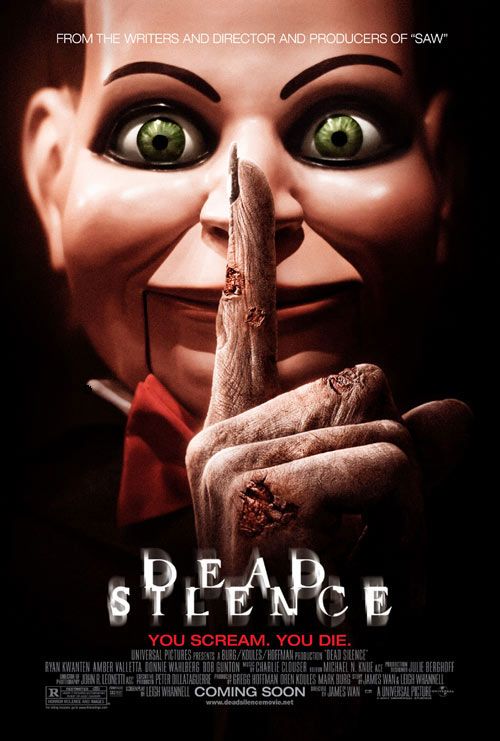
Dead Silence (2007) dir. James Wan


James Wan and Leigh Whannell have hit my horror sweet spot. Insidious (2010) provided the duo with a commercial success to distance them creatively from their earlier creation of the often maligned Saw franchise, but they'd developed an even bolder departure a few years earlier with their immediate follow-up to Saw (2004), Dead Silence. This film taps into a vein of retro horror that most modern filmmakers leave untouched: the extravagant, potentially corny, earnest shriek shows of the 1950s and earlier. Though updated for contemporary sensibilities in terms of its violence, editing, and cinematography, Dead Silence is virtually a hyperactive episode of The Twilight Zone mashed up against an EC horror comic. Its locations are moody and sound-stagy, giving the viewer the impression that the long abandoned sets of classic Hollywood horror were resurrected, having been twisted by time into even more expressionistic structures than they were before. The nursery rhyme mythology that the film creates for its villain, coupled with the story's frequent violations of mimetic narrative logic, hint that this is a film best suited for the fertile and accepting minds of a younger audience, eager to squeegee away such perceived flaws in favor of soaking up its excess of imaginative qualities. The film's R-rating implies either a miscalculation on Wan and Whannell's part or the inability of the MPAA to understand how desperately the thirteen-year-old crowd needs exposure to this sort of nightmare. They are, after all, our horrifying future.


The Watcher in the Woods (1980) dir. John Hough


A film I wish I'd peeped as a child, John Hough's Disney-produced The Watcher in the Woods was filmed shortly before he made The Incubus (1982) with John Cassavettes, a film about a demonic entity raping women to death. Though Hough had already made the fairly strange Witch Mountain films for Disney, the director of suggestive, sexually-charged films like Twins of Evil (1971), The Legend of Hell House (1973), and Dirty Mary, Crazy Larry (1974) is still a peculiar but welcome choice as a director of children's cinema. Appropriately, The Watcher in the Woods, adapted from a pretty odd-sounding 1976 young adult novel written by Florence Engel Randall, is more bizarre and frightening than anything I've yet seen from the house that Mickey built. One part Nancy Drew mystery and two parts alien-encounter-masquerading-as-a-haunted-forest trans-dimensional mini-epic, the film is-- even in its toned down theatrical version-- pretty wild. The studio's post-production tinkering with the film's ending has been well documented, but both of the alternate versions of the ending must be seen for the viewer to achieve a full understanding of the trippy, horrifying, head-scratching cosmic insanity the filmmakers were intending. Besides these joys, the film also presents young viewers with the positive role model of a brave, inquisitive, and independently-minded female protagonist in the character of amateur sleuth Jan Curtis (Lynn-Holly Johnson, in a performance that loosens Carroll Baker's usual stranglehold on the award for most wide-eyed overacting in whatever film she's starring in). If Disney had refrained from meddling with it in post, The Watcher in the Woods could have become a minor classic, terrifying and transporting the minds of its child audience to new planes of cinematic existence and possibility. As it exists, it's that sort of weird and confusing Disney movie half-remembered from many childhood VHS rentals.