
Nine rich people who hate each other follow a guy who looks like Ralph Bates in
Taste the Blood of Dracula (and who may be a ghost??) back to an old, abandoned theater that one of them owns (dubbed by one character as "Dracula's summer home") because the party they were at was too boring. Where this film goes right is in its expression of the utter loathing and hostility these characters feel for one another--it's wall to wall snarkiness for the most part, with everyone mercilessly deriding everyone else to their faces and very calmly and glibly accusing each other of murder (one of the guests quips, "you're so civil while tearing each other to pieces"). I'd placed all the films I wanted to watch during this Meltdown into a list randomizer to determine the viewing order, and somehow this was the best possible option that could have wound up in the initial position. It has a wonderful mood and atmosphere that's sucking me right into the spirit of things (the musty theater is a superb location; see, for instance, the sequence wherein a handheld camera explores the eerie, wind-jostled curtains of the empty stage for nearly a minute). There's talk of a 100-year-old birthday curse taking its inevitable vengeance on the guests, which gets me excited because mixing a sense of the paranormal (even a misleading Scooby Doo sense) or Gothic elements into the giallo formula is a nearly surefire way to have me grinning. We get moving mannequin and suit of armor gags, a killer wearing a mask featuring an obscenely bushy unibrow, and one of the very best surprise murder scenes I've seen in some time (in cheeky fashion, the conclusion of
Romeo & Juliet is turned actual rather than dramatic). As the film ends, I have the feeling that 20 more like this would be breezy.
Body Count: 8

Phantom of Death (Un delitto poco comune) (1988) dir. Ruggero Deodata
And then Ruggero Deodata (Cannibal Holocaust, The House at the Edge of the Park) goes and ruins all my hopes and dreams with Phantom of Death, which--while never less than decent--is not the creamiest yellow crop. In fact, it's tough to even call it a full steam giallo--there's a brief mystery element in the first 20 minutes (by way of a bizarre opening montage featuring Michael York playing at a piano recital, a fully-regaled ninja practicing with his sword, and a lab technician being murdered after tinkering around with a microscope), but it's rather quickly discarded in favor of a fun but tension-less cat-and-mouse police procedural between the literally diseased killer and the inspector tracking him. That inspector is played by the inimitable Donald Pleasence, who in every scene looks as if he was just woken up from a nap. It's a weak showing on Pleasence's part and you can tell he's not overly engaged in the material, which is problematic considering so much of the film's latter half rests on him. To make up for it, we do get a bit of the lovely giallo stalwart Edwige Fenech (in, sadly, her only Meltdown appearance) who looks really great here, far removed from her typical early 70s milieu, barring her dreadful late 80s fashion and hair styling. If nothing else, the film has an abundance of gushing arterial bloodspray (which is rarely a detriment) and a swell Argento-esque body-crashing-through-mirror scene (which, little could I have guessed, would become a recurring image as my days wore on). Also, as far as I know, it's the first Progeria exploitation film, so there's that. Body Count: 6

You Will Die at Midnight (Morirai a mezzanotte) (1986) dir. Lamberto Bava
This Bava schlockfest begins with the goofiest Claudio Simonetti score my ears have ever been blessed with; it's got the real bright idea of mixing classical strings with a New Wave beat, and I'm pretty sure later on Simonetti even cannibalizes musical phrases from his own score for Deep Red. Visually, it begins with a skeevy dude peeping on his wife shopping for underwear and witnessing her engaging in an illicit liaison. Naturally this leads to some marital strife which quickly devolves into the laziest murderous marital struggle ever committed to celluloid. When the wife soon after winds up all dead, of course the husband is the prime suspect. But is he the killer? Is he!? Several pickled snakes and missing pipe jokes later, the answer is who cares. The film's late highlight is when a girl attempts to ward of the killer with a whirring electric mixer but simply crumples and waits for death after the plug is pulled from the power outlet (after dispatching of her, the killer then grinds a bit of her into some blood stew with said mixer and pours it out on the kitchen counter. Just because). There are some effective moments as the films winds down: I'm thinking particularly of the killer's unnerving physicality when chasing after the heroine and a pretty neat scene on a foggy beach. To bring it all home, we end with the socially responsible message that being the victim of rape almost inevitably leads to one becoming a psycho-sexual killer. The more you know! You Will Die at Midnight is entertaining enough in part, but not exactly up to Lamberto Bava's usual cheesy standards (for that I tip my hat towards a few of his other gialli: Delirium: Photos of Gioa, A Blade in the Dark, and the legitimately great Macabre). After a quite abrupt ending (which will be another transfilmic motif) and as the credits rolled, my eyes started burning. This turn of events did not bode well for my endurance, being only 1/7th of the way through my journey. After draping a hot, wet towel over my eyes, it was time to move on. Body Count: 7

Plot of Fear (E tanta paura) (1976) dir. Paolo Cavara
Paolo Cavara's wonderful Plot of Fear heals my ailment: it's an incredibly fun, loopy mystery that sets off at a brisk pace and carries it throughout (we have two seemingly unrelated murders within the first five minutes, one of which features a prostitute strangling her masochistic client--now there's a neat reversal for you). What else helps make it a winner is that the film is very jokey: we have a bored convict offering the police a psychological profile of the killer, a cuckolded husband getting all hot and bothered over covert photographs of his wife and her lover, a maid loudly masturbating while standing in the bathroom as her employers stand outside, and (strangest of all) a cartoon pornography screening party with a chimpanzee in attendance (this also with the acknowledgment that the aforementioned cartoon porno is the craziest thing I have ever seen). This is the type of film where the central inciting crime involves a group of party-goers "jokingly" attempting to feed a prostitute to a tiger, only to have her die of fright on them (and that's simply the cover story). There's also a good cast backing it up. Eli Wallach and Tom Skerrit are in attendance in smaller roles. Corinne Clery (The Story of O) brings her skillset to bear in the film's primary love scene, enthusiastically jamming her tongue into the lead detective's mustache. That detective, Insp. Lomenzo, has his own off-kilter eccentricities that brighten the proceedings. He's the type of guy who hates macrobiotic food, loves gigantic bowls of spaghetti, claims that his "frontal lobes are highly developed," and has a framed print of Snoopy howling "BOOOOOOOOOO!" hanging in his living room. The mystery plot loses me a little bit in the final moments, but it's probably my own fault. This is a good one. Body Count: 9 (+ 1 pig)

Crimes of the Black Cat (Sette scialli di seta gialla) (1972) dir. Sergio Pastore
The title of Pastore's film literally translates to Seven Shawls of Yellow Silk, which is a) a much better title and b) puts it in league with all those other gialli that are part of the unspoken agreement to transform "7" into the unluckiest number of all (see: Seven Blood-Stained Orchids, Seven Deaths in the Cat's Eye, The Red Queen Kills Seven Times, Seven Notes in Black, etc). Released in 1972, Crimes of the Black Cat hit Italian cinemas the year after the genre reached both its creative and popular peak, and it's a film that rides far off the fumes. Besides the requisite rash of killings, the film has another creative mystery angle focused around the killer's methods: somehow a cat jumping out of a wicker basket is frightening people to death, and the interested parties must find out why. The film also features two separate investigations (and primary investigators) of the crimes with each given equal attention by the narrative, which is a choice that appears somewhat unique in the gialloverse (at least based on my viewing record). Add to that the fact that one of the investigators is a suave, wealthy blind man who never loses his ingenuity or his cool, even when accidentally bumping into corpses (and who also easily out-handsomes Karl Malden in The Cat O'Nine Tails), and we're left with a hero pretty close to a vigilante crime fighter (shades of Matt Murdock/Daredevil). Crimes of the Black Cat probably isn't as accomplished as a film like Plot of Fear, and yet it's still emerging as my favorite so far. It has an inspired lunacy and sense of reckless, stylish abandon that earns it a place slightly higher in my personal giallo hierarchy. We receive such visual treats as countless fast zooms into extreme closeups of growling cats, a man falling into a vat of boiling milk (?), and a tonally-inappropriate shower slashing that serves to unnerve (even more so due to the fact that, as brutal as it is, the print I saw looked to be missing some frames). After another crazy-abrupt resolution and a slow-motion Argento plunge through a window, we're on to the next course. Body Count: 8 (+ 1 cat)
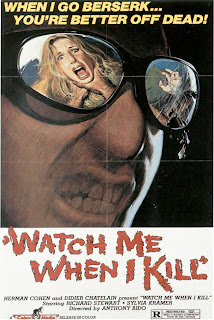
Watch Me When I Kill (Il gatto dagli occhi di giada) (1977) dir. Antonio Bido
Director Antonio Bido would helm the somber and skillful Bloodstained Shadow a scant year after Watch Me When I Kill, so it's a bit off-putting to find the latter so lacking in the merits of the former. I'm going to chalk at least some of this disappointment up to the quality of the version I'm watching; its sub-VHS picture and excessive cropping on all sides of the frame--producing little more than a series of extreme, claustrophobic closeups--are tough to absorb yourself into. Regardless, it's not without its charming quirks: one woman suffers death by green slop and potatoes, an old man takes a bath in Drano, and the hero works his detection through doodling. Speaking of the hero, he's sort of unique, too, in that he's not sparked on in his investigation by egalitarian ideals; he's not as interested in stopping the killer and bringing him to justice as in convincing him to buzz off and leave his girlfriend alone. It's a rare, pragmatic position for a protagonist in one of these films to take, and not unappreciated. The film begins to resemble the Bido of a year hence in the third act, where the motivation behind the killings takes on a strangely serious tone, bordering on the exploitative. See, it's actually all about Jewish revenge against Nazi collaborators. This revelation is about as left-field as it reads, but it leads to a conclusion more compelling than the film that has come before it. And, even with the stiff competition, Watch Me When I Kill also holds the crown for the most abrupt ending of all (one that did not fail to make me laugh so hard that it came out more as a snort). Onward to the end. Body Count: 6

Murder Rock (Murderock - Uccide a passo di danza) (1984) dir. Lucio Fulci
I end my first night not with a bang, but a sweaty dance routine in aerobics gear. A dance and slash epic conducted by maestro Lucio Fulci starring Ray Lovelock and Olga Karlatos sounds like an incredible composition on paper, but the end result is hardly a tune worth whistling. It's a dull, lazy picture that features not nearly enough dancing or slashing to sustain its running time. Viewing it around one in the morning, I was having difficulty paying attention to begin with, and the film offered little to remedy this. This said, it's not completely devoid of interest. Some fun things: the dancing is suitably energetic, though there is far too little of it; the killer's M.O. provides some much-needed creative suspense, even if it's far from medically accurate (he chloroforms his victims and then sticks a long pin into their hearts (or left collarbone, more precisely) to stop them); and we have a couple-few moments with the creepy child actress from Fulci's own House by the Cemetery, here playing a similarly creepy bug-collecting, wheelchair-bound weirdo. The film is a non-starter, and by the time it inanely flashes a quote from John Huston on screen before the closing credits I find myself actively disliking it. Coming from the man who directed some of the best gialli out there (Don't Torture a Duckling, Lizard in a Woman's Skin, Seven Notes in Black), Murder Rock is a sore disappointment and a real bummer to end my night on. For now, I must sleep, and perhaps tomorrow will provide yellower pastures. Body Count: 5 (+ 1 bird)
Saturday
The Girl in Room 2A (La casa della paura) (1974) dir. William Rose
The start of day two and we're immediately back on track. We begin with some jaunty music and a ritual stabbing. Good morning! This is a spoiler, but: I ended up liking The Girl in Room 2A quite a lot. A bit of an oddity, it's a giallo filmed in Italy and starring Italians but produced and directed by Americans (the producer was Dick Randall, that wonderful bozo behind Pieces). Regardless, it fits seamlessly into the wider body of gialli being produced in the mid 70s. It's slow and moody, working on its own internal logic that you have to come to accept (for instance, it's not rational for the heroine, after moving into a new room, to clean up a puddle of blood she finds under a rug instead of, you know, inquiring about its origins, and yet that is what she does. And, in the moment, it almost makes sense). Again, it's an example of a giallo employing Gothic horror elements to great effect: we find weird mannequins, mini-guillotines, medieval torture dungeons, and carpets spurting blood of their own accord. The script also has a bit of a chip on its shoulder in re: the fallibility of the justice system and the need to punish criminals and sinners outside of the law--many of the speeches it gives to its cult member villains sound all too earnest. Makes you wonder. Body Count: 7

Nothing Underneath (Sotto il vestito niente) (1985) dir. Carlo Vanzina
Nothing Underneath is the sort of silliness I had wanted from You Will Die At Midnight. Like that film, it's coming way late in the giallo cycle (for all intents and purposes, the genre was dead by the time the 80s rolled around), but it uses the new decade's cheesy extravagance to its advantage. Donald Pleasence makes his second Meltdown appearance, this time sporting an accent and more vigor (see, for instance, the dedication he imparts into chowing down on a burger at Wendy's while rocking a napkin bib, in the film's tastiest scene). The film's premise concerns fashion modeling (naturally) but also a psychic connection between twins--when a country bumpkin has the psychic twinge that his sister is in trouble, he quick hops onto a jet to Milan and spends the next hour and half doing a fish out of water routine. Tom Schanley has some pretty dreadful chops, but he somehow manages to make the character come across as the endearingly clueless type (and anyway, Worst Actor goes to the Asian photographer, who both receives the honor of delivering the titular line and is the worst goddamn actor I've ever seen). The generally fluffy proceedings are bolstered by a great Pino Donnagio score and a strong final act, but this (like so much of the 80s stuff) is too easily dispensable. Unbelievably, we end on another slow motion broken window jump (although this time with an extra corpse in tow). Body Count: 5

Weekend Murders (Concerto per pistola solista) (1970) dir. Michele Lupo
I appreciate the title's sort of bland frankness ("Yes, Nigel and I were just about to pop off to the cottage this weekend for some murders"), and it's fitting considering the film's dry humor (its literal title translates into something like "Concerto for Solo Gun," which explains the film's insistence in placing lots of nondiegetic gun blasts over the audio track whenever a body is discovered, even when it's a stabbing victim). Weekend Murders is an enjoyable romp, even though it falls far closer to an English parlor mystery than a giallo (it even ends with a great "round up all the suspects" reveal and explanation). Fittingly, it is trying awfully hard to appear English, and sort of succeeds despite itself. Even though casting the beefy Italian Gastone Moschin (Ugo Piazza in Fernando Di Leo's incredible Caliber 9) as a bumbling constable seems misguided, he totally pulls it off, winding up as a supremely likable accidental detective. His two man comedy act with the untalented, credit-hogging Scotland Yard detective ("I've filled up ten expensive looking little notebooks and now know even less about this case than before") propels the film through any rough patches. Though, as luck would have it, there aren't many--the mystery suffices, and the comedy hits more than misses (my favorite quip, coming immediately after the discovery of a strangled corpse, is when Georgie, the sexually repressed momma's boy, laments that the killer is "not very imaginative"). Chalk me up as pleased. Body Count: 5

Orgasmo (1969) dir. Umberto Lenzi
No three day stint of brain damage is complete without a touch of Lenzi. I can't recall ever experiencing such a 180 degree turn in my opinion of a film while in the process of watching it. For the first half an hour, Orgasmo felt unbearable. Aided by a go-nowhere romance plot and Carroll Baker's histrionics, I was ready to start slamming my head against the table to stay awake. Then, out of nowhere, Lou Castel's character starts to take on some menace, and when joined by his "sister" that menace actualizes itself. This movie is incredible. Perhaps it's simply my sadistic pleasure in watching Baker be psychologically tortured for forty minutes, but I was riveted. For a film that's so openly melodramatic (thanks, Carroll), the number of quiet moments of suspense is impressive. Moreover, it discovers its own sick sense of humor (watch out for my favorite scene of overacting, as many pitchers of liquid are thrown and overturned for desired effect). A fantastic resolution with some predictable comeuppance for the guilty parties, and I couldn't be happier. This is my favorite film of the Meltdown. How did this happen? Also: I believe (if nothing has been overlooked) that Orgasmo provides our first J&B sighting. Drink 'em if you've got 'em. Body Count: 3

The Bloodsucker Leads the Dance (La sanguisuga conduce la danza) (1975) dir. Alfredo Rizzo
How can a film with such a title be so very dull? We've hit a low with Bloodsucker, which I'm going to try very hard to find something nice to say about (to challenge myself), but which in fact discovers new levels of tedium. So let's be nice: 1) the period setting is welcome and the sets/costumes are competent, 2) it's utilizing the same legend/history as Paul Naschy's excellent Horror Rises From the Tomb and Panic Beats, 3) the characters conveniently dig visible graves for the deceased so I could easily keep track of the body count while my attention drifted up and away. Bizarrely innocent lesbian exploitation and a paper-mache severed head do little to elevate this dreck. And that was me trying to be generous! Blech. Body Count: 3
Death Walks on High Heels (La morte cammina con i tacchi alti) (1971) dir. Luciano Ercoli
I won't bury the lead: Death Walks on High Heels was a disappointment. I adore Ercoli's other Susan Scott giallo vehicle, Death Walks at Midnight, but this one lacked the panache and levity of that little yellow gift. This said, High Heels is decent enough, with a good cast in support of it: Frank Wolff, Susan Scott, and the ever-oily Luciano Rossi (here doing his best Dr. Claw impression over a decade before Inspector Gadget first hit airwaves. Rossi was always literally ahead of his time). It's pretty gory in certain sections and makes the surprising choice to kill off one of its leads about halfway through. Still, there's just not much else here to latch onto. However, it does possess one of my favorite goofy endings so far, as the picture freeze frames on the tableau of two inspectors staring lovingly into each other's smiling eyes as the younger lights a cigarette for his superior. But if that's the most interesting thing to end up in my notes, I'm less than convinced that this one is a gem. I'll always have the impeccable Stelvio Cipriani score to persuade me that my memories of it should be fonder than it deserves. Body Count: 4

Giallo a Venezia (1979) dir. Mario Landi
Perverted trash. That statement is not so much an insult as an accurate reading of this film's concerns. Giallo A Venezia is more or less a poor softcore porn film with the occasional scene of a prostitute being stabbed in the groin or a man being burned alive (his eyeballs unnervingly still rolling after the flames die out on his charred corpse). A Radley Metzger-level softcore giallo might be something to reckon with, but pretensions towards art is a truly foreign concept to this film. This said, there's still something sadly appealing about it, rendering it a more honestly enjoyable romp than either of the last two entries. For one, Jeff Blynn's Inspector DePaul is one of more amiable detectives I've encountered, and he deserves a place in a better movie. Looking like a shaggy, mustachioed, blonde Richard Gere, he woos me with his habit of keeping hard-boiled eggs in his coat pocket at all times, peeling them and chowing down at every inopportune moment. But, naturally, the procedural elements take a distant backseat to the sleazy sex stuff, which couldn't get much sleazier: marital rape set to big band music, female masturbation segueing into a brutal whipping, public exhibitionism, and (strangest of all) the massaging of the folds of a vagina-like mussel in a shell with an unlit cigarette. Moreover, the VHS composite cut I viewed even contains a scene where a man actually whips it out and starts jerking it in a movie theater. Classy stuff. It ends, and we and DePaul discover that the central mystery was no mystery at all. Figures. Regardless, this was an odd film to end the night on. I dread what dreams may come. Body Count: 5
Sunday
The Sweet Body of Deborah (Il dolce corpo di Deborah) (1968) dir. Romolo Guerrieri
Let day three commence. We start here, with this fun early entry in the genre. First off, check out this cast: Jean Sorel, Luigi Pistilli, a bearded George Hilton, and... Carroll Baker. Well, maybe it'll be like sweet and sour? Actually, she's fine here, and it's more Sorel's show anyway, despite the title being in reference to her character. Sorel plays a recently married man whose old girlfriend may or may not have killed herself because he took some of her money and then bolted in order to marry Baker instead. Pistilli plays an old friend who follows the newlyweds and tries to guilt Sorel/drive Baker insane (which, as her filmography has taught us, is not a particularly difficult task), and Hilton is a suave artist lodging in the villa next door. I don't know, but I think somebody is up to something! In fact, almost everyone is up to everything, as The Sweet Body of Deborah is almost entirely composed of double crosses in its homestretch. All of it is fairly standard twisty-ness (no revelation will surprise or bewilder), but it's handled if not with skill or flair then at least with competency by director Romolo Guerrieri. It reaches for the Gaslight angle with some ghostly happenings at the "dead" ex-girlfriend's house, and grasps for the crazy straw with a musical Twister love scene. Featherweight entertainment, and a solid beginning to my end. Although brace yourself for this body count: Body Count: 1

Psychout for Murder (Salvare la faccia) (1969) dir. Rossano Brazzi
Psychout for Murder is a fantastic, melancholy little film--and one of the better films I've watched so far. Can't really call it a mystery so much as a Hamlet revenge plot, with the entrancing Adrienne Larussa feigning madness in order to covertly punish her family for their crimes against her. Larussa has a remarkably strong screen presence in the film--she looks like an equal blend between Franco muses Soledad Miranda and Lina Romay, while displaying the distinctive traits of each (Miranda's sensuality and Romay's doe-eyed innocence). She carries the film well as it escalates into a an ending that eschews the typical third act bloodbath in favor of the establishment of an understated private hell for both the heroes and villains (discounting the fact that the film makes it awfully tough to distinguish between the two). Psychout for Murder also has a lot of style (several classy quasi-montages of fast cuts set to trippy music) and creativity (Larussa's character constructs several ingenuous death and seduction traps that MacGyver would envy). The only thing that might irk some is the almost constant reprisal of the film's theme, an icky little tune sent from a daughter to her "daddy." Body Count: 2

Smile Before Death (Il sorriso della iena) (1972) dir. Silvio Amadio
Despite the presence of the lovely Rosalba Neri (in her second Meltdown appearance), Smile Before Death doesn't do all that much for me. Directed by Silvio Amadio of Amuck! fame, I suppose I expected something a bit more engaging. It's by no means a bad film, just a little tame. It's weird and pervy without being weird and pervy enough. A teenaged girl's mother commits "suicide," so she is sent to live with her stepfather and his mistress (a photographer--now the title makes sense to you). Almost immediately, the mistress (Neri) is getting the teenaged stepdaughter all naked to model for her lens ("Turn to me like a quivering faun in the woods") and the stepfather is playing creepy tickling games with her. On reflection, I guess it is a pretty weird and pervy film, but after Giallo A Venezia most of this stuff feels a little pedestrian. It has a slew of similarities to immediately previous Meltdown entries: absurd overuse of main theme (Psychout for Murder), double crosses galore (Sweet Body of Deborah), closing car crash karmic justice (Orgasmo). Unique to this film is a pretty neat locking-a-door-from-outside-with-string trick that I'm pretty sure couldn't work IRL. Oh well, it's probably worth a watch if for nothing else than the goofy photoshoots, replete with the silliest wigs and outfits that the early 70s had to offer. Body Count: 3

Puzzle (L'uomo senza memoria) (1974) dir. Duccio Tessari
All around solid mystery thriller. I enjoyed this one a ton. It has a nice classical style and sense of professionalism to it--lacking rough edges, Puzzle is some straight ahead no bullshit suspense. The premise may be tired but it's delectable in this context: a man with amnesia resurfaces after nearly a year of being MIA and quickly becomes embroiled in a botched heist that he is said to have been a part of. Is he responsible, or are we dealing with a case of mistaken identity? Is his amnesia real or a put-on? His abandoned wife and previous partners in crime are eager to find out, and, heck, so was I. What else takes the film above its standard plot is the emphasis it places on the redemption and revitalization of the two protagonists' marriage. It's a sweet touch for the story to have and one that is, thankfully, unspoiled by any final act plot twists. Fun things from my notes: is naming your dog "Whiskey" the sign of a serious drinking problem? ("Good, Whiskey," "Fetch, Whiskey," etc.); the sharing of an apple/kiss feint; zipper-to-straight razor reveal; chainsaw vs. chair; "New York? Ah yes, that's in America isn't it?" Body Count: 4 (+ 1 dog, RIP Whiskey)

The Flower with Petals of Steel (Il fiore dai petali d'acciaio) (1973) dir. Gianfranco Piccioli
I'd call The Flower with Petals of Steel a victim of my exhaustion if not for my overly positive feelings for the two films that follow it in this patience-testing marathon. Something about this one failed to connect with me. It's slow-going, and the central mystery/dilemma never gains any momentum, considering that anyone with half a cinematic-brain understands that something is awry in the inciting accidental death--although, to give the film credit, when the solution is provided in the film's coda it's more preposterous than anyone could have ever imagined (brace yourself: underwater scuba diving lesbian love scene). If the film was skewed a bit more towards this brand of inanity, at least I'd have something to write about. As it is, there's not much here. Gianni Garko (Night of the Devils) and his Wrong Man Who Sleeps with Everyone routine is only cursorily compelling. Carroll Baker is here (again; how did I let this happen?), but in a weary, subdued, barely there performance--I almost missed the rambunctious version of her; a little bit of CB at full blast could have livened up the picture. There's another J&B sighting, a surgeon disposing of a corpse himself by first removing the spine in order to prevent rigor mortis, and the aforementioned scuba diving euphoria, but otherwise I'm spent. Of all the films I was lukewarm on, this is the one I'd be most anxious to revisit at a later date and with a clearer head. Maybe its appeal is too subtle for a psyche as damaged as mine was entering into it. This is film 19 after all. Regardless, I adore the above poster. Body Count: 2

Death Steps in the Dark (Passi di morte perduti nel buio) (1977) dir. Maurizio Pradeaux
The penultimate stop on my journey, Death Steps in the Dark is easily the most fun I've had so far. Like Plot of Fear, it's almost as interested in the comedy elements as it is with the bloodletting, although I'd argue the humor is more successful here if only because of how lighthearted and off-color some of it is (a lot of near slapstick, flavored primarily with misogyny and peppered with a little bit of homophobia. None of it comes off particularly hateful so much as misguided and almost charmingly juvenile. Like a giallo meant to hold the attention of children. Approximation of choice line: "A man doesn't buy another man a first class train ticket unless he's gay. Wait a minute... was he gay?!"). The premise is standard murder mystery fare (a light goes out in a crowded train car, and when it flickers back on a passenger lies dead), and it's competently strung out across the film's running time. Leonard Mann plays our supremely weaselly hero, Luciano Morelli, who seemingly hates his adorable--if a little airy--girlfriend Ingrid. At one point, he also has the bright idea of crossdressing in order to prevent detection by the police (he has at least one outfit change in this phase. Both choices aptly demonstrate a complete lack of fashion sense). The Looney Tunes antics escalate as Luciano and Ingrid pick up a young and beautiful female accomplice named (Little) Baffo, whose father was such a master safe cracker that he wrote a book about it. The antics the three of them get into involve, among other things, a gorilla mask. By the end, I had decided that I'd happily watch another hour and a half of Ingrid and Baffo doing their confused comedy routine with Luciano whimpering somewhere in the corner. In short: five bloody stars. Body Count: 5

A White Dress for Mariale (Un bianco vestito per Mariale) (1972) dir. Romano Scavolini
And here we are. A White Dress for Mariale is very nearly great, and, as is, is pretty darn good. Although coming fairly early in the giallo cycle, it's closer to being an out-and-out slasher (the title fits it better than it does the next year's Torso, which is oft-cited as the Italian proto-slasher par excellence, but only lives up to it in the last 20 minutes). But Mariale's slasher stampings make sense, considering director Romano Scavolini would go on, nearly a decade later, to craft the video nasty slasher classic Nightmares in a Damaged Brain (which I really need to sit down and watch someday soon). This is a film of abundance. Almost as if it were trying to make up for the paucity of Sunday's bloodshed, A White Dress for Mariale features eleven murders, three of which occur in the film's first two minutes. Practicly running out of the gate, the film never quite stumbles--the major issue is that the narrative is a bit undercooked. The central mystery behind Mariale and the cloistered treatment she receives at the hands of her paranoid husband (the great Luigi Pistilli) is intriguing, but the narrative finds little of interest to expand upon in the backgrounds of the numerous party guests invited to Mariale's masquerade (chief among them the dashing Ivan Rassimov, who--though the film's protagonist--has very little to do here. It's a waste, because he genuinely is the best dude). Instead, they serve as fodder for the lightspeed bloodbath that hits the last 20 minutes. But isn't that the point of a slasher anyway? Why am I griping? There's so much to feast upon here: an absolutely wonderful Gothic horror element (including a perplexing scene involving corpses and gale force indoor winds), a gorgeous Bruno Nicolai score, and a very satisfying circular ending. There's even a surplus of beloved absurdities, including the seduction of a suit of armor and the demise of a mechanical snake, expertly blasted off the ankle of a partygoer with a revolver. I think I'm changing my mind as I write all this. This film might actually be perfect. But who can tell? There's no way that I'm the best judge. I just watched 21 movies in a row and am assuredly a lost cause. Now: what to watch next weekend? Body Count: 11 (+ 1 bird, 1 mechanical snake)
Final Body Count: 109 humans, 2 birds, 1 dog, 1 cat, 1 pig, and 1 mechanical
snake.
Favorite Films: Crimes of the Black Cat (Friday), Orgasmo (Saturday), Death Steps in the Dark (Sunday)
Blech Films: Murder Rock (Friday), Bloodsucker Leads the Dance (Saturday), The Flower with Petals of Steel (Sunday)
Highest Body Count: A White Dress for Mariale (11 humans, 1 bird, 1 mechanical snake)
Lowest Body Count: The Sweet Body of Deborah (1 human)
Best Mustache: Insp. DePaul in Giallo a Venezia
Most in Need of Mustache: Ray Lovelock in Murder Rock


